promanage.testmagna.com

Author: yonetici

  • How to Improve OEE?

    What is OEE?

    OEE, or Overall Equipment Effectiveness, is a standardized measurement parameter used in production operations to identify problems, determine the efficiency of various areas and percentages of production, and monitor business processes.

    The OEE calculations, which are a crucial tool for Lean Manufacturing and TPM (Total Productive Maintenance), highlight significant production losses to recover hidden capacity within the production process.

    Improving OEE thus translates into reducing production losses and enhancing production capacity.

    To improve OEE in production, focus must be placed on three key factors: Availability, Performance, and Quality.

    • Availability Factor: Represents downtime losses caused by machine or equipment breakdowns, setups, setup adjustments, and waiting times during production.
    • Performance Factor: Represents losses due to short stops and reduced speed in production.
    • Quality Factor: Represents defects, NOKs, rejections, and scrap, including rework in the production process.

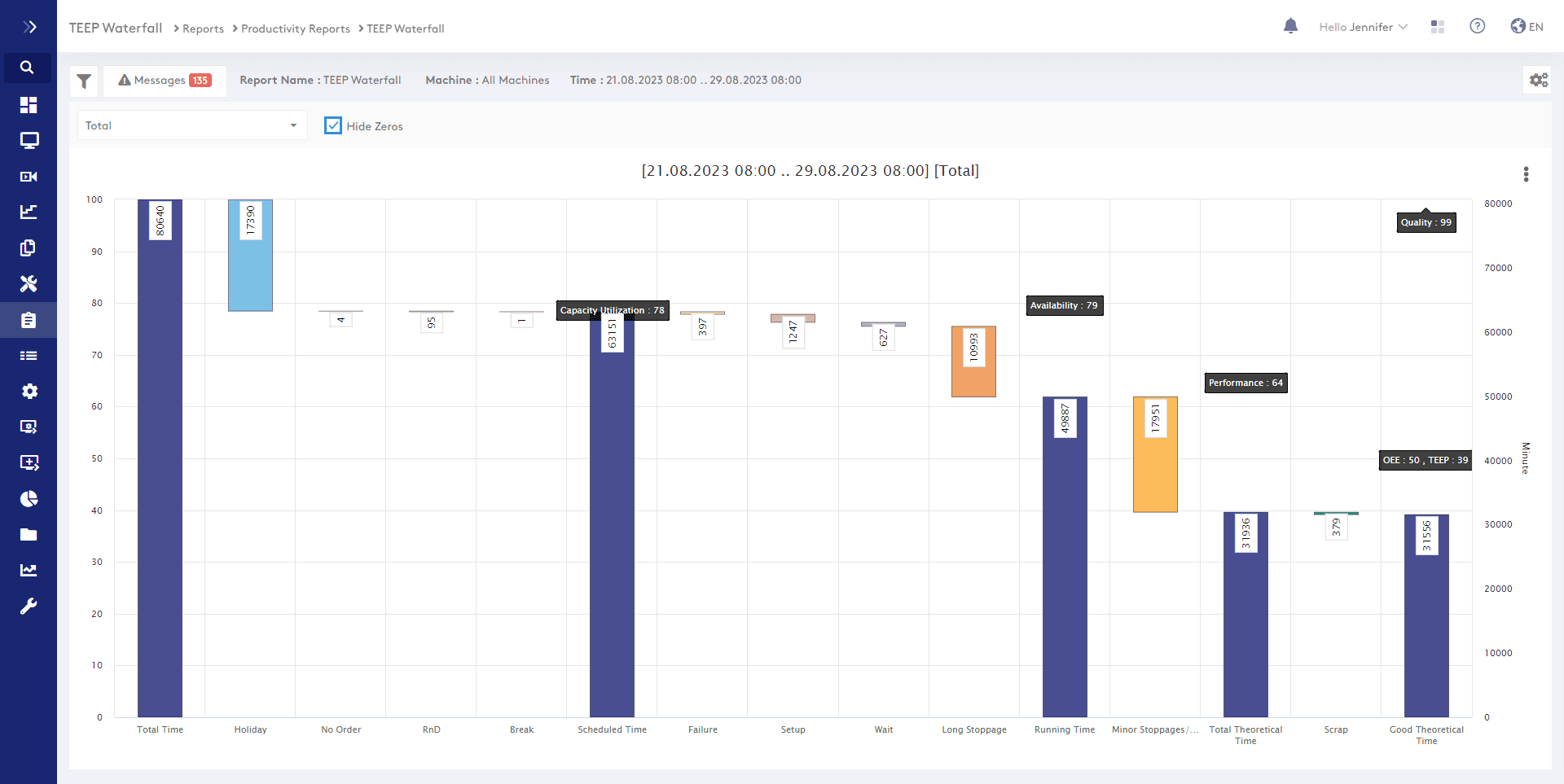
    TEEP Waterfall Report

    TEEP Waterfall Report

    Global factory targets that companies should strive for are defined based on practical experience. These targets are 90% for Availability, 95% for Performance, 99% for Quality, and 85% for OEE. Looking at these targets, the OEE values of facilities awarded the prestigious “Excellence in TPM” in Japan are consistently above 85%.

    Today, many manufacturing companies have an OEE score close to 55%. However, among hundreds of manufacturing enterprises analyzed by ProManage, the number of those with an OEE score below 45% is higher than those with a score above 75%.

    How to Improve OEE Values?

    The first step in improving OEE values is the accurate analysis of data collected from machines and operators. Reducing human dependency in the production process and utilizing sensors and machines to read data enhance the accuracy of production data.

    OEE improvement activities involve identifying and analyzing the root cause of problems and can be grouped as follows:

    1. Firefighting: Immediate action must be taken to extinguish fires as they occur. The subsequent step involves working on how to prevent similar fires in the future. Real-time data in production assists businesses in identifying speed reduction issues in machines at the moment and taking immediate action, thus minimizing production losses.
    2. Fire Prevention: At ProManage, Six Sigma projects or Kaizen practices are implemented to prevent fires before they occur. These practices aim to ensure excellence in production by defining, measuring, analyzing, improving, and controlling processes using statistical tools.

    It is worth noting that activities for improving OEE values are not limited to firefighting (reactive maintenance) or fire prevention (proactive maintenance).

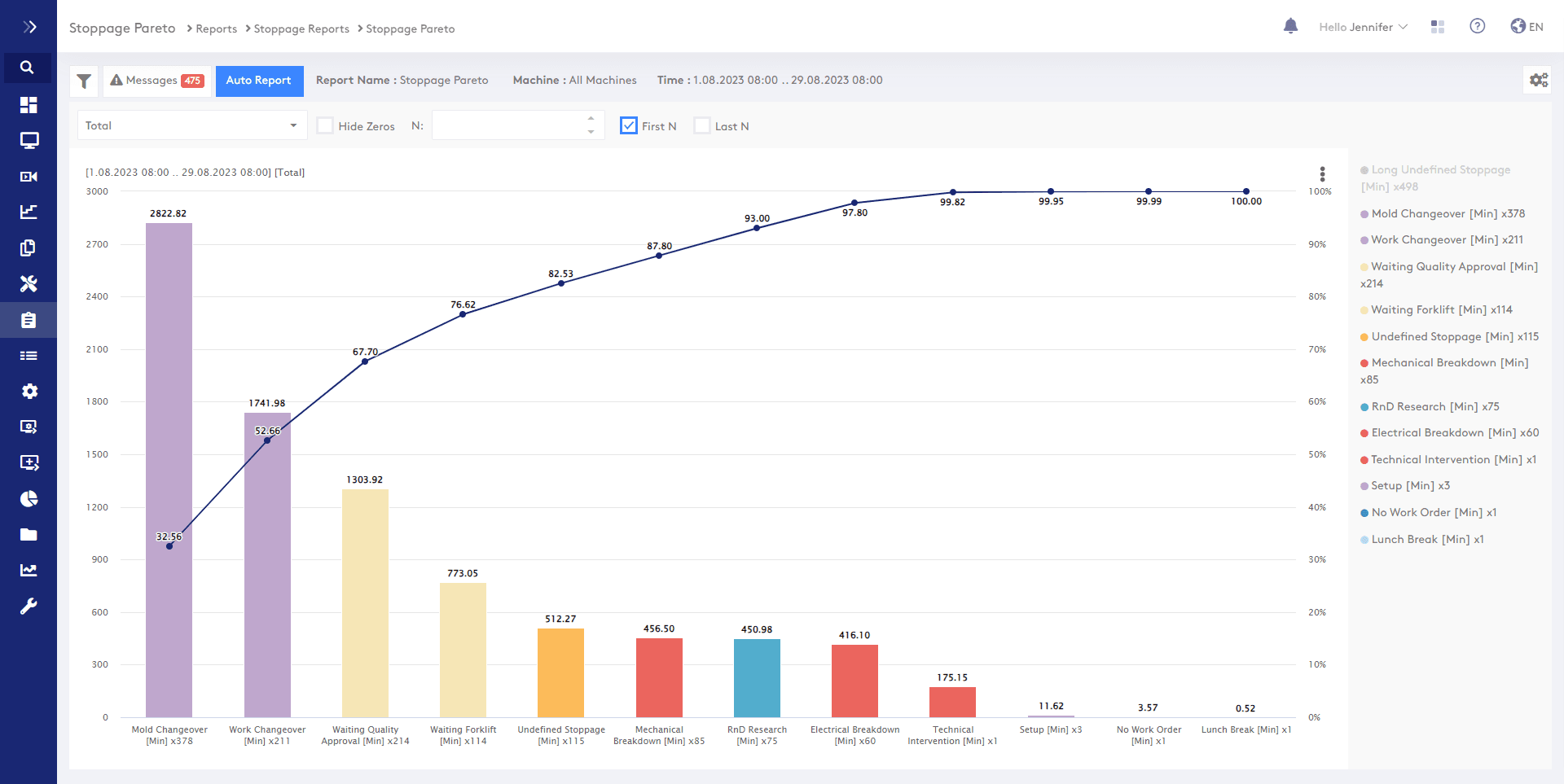
    Stoppage Pareto

    Stoppage Pareto

    Perceptual and Systematic Improvements

    OEE improvement activities can also be categorized as Perceptual and Systematic improvements:

    • Perceptual Improvements: Based on the approach that “if you are aware of a problem, you can solve or improve it.” Most perceptual improvement ideas come from workers, are less likely to result in radical changes, and are therefore easier to implement. These small-scale operational improvements generally require less significant capital investment compared to major process changes.
    • Systematic Improvements: These are driven by analyses and require detailed and reliable data to be effective.

    Tools to Help Improve OEE

    Reliable and real-time data is indispensable for improving OEE in production. The core system relies on automatically collecting data from machines in real-time.

    By automating the data collection process, the core system eliminates human dependency in many manufacturing facilities where data is traditionally collected manually using forms. Manual data collection, often conducted at the end of a shift, leads to delays and inconsistencies in reports, making the data less actionable.

    Automated, real-time data collection is essential for obtaining reliable data, enabling management to make informed decisions and consolidating all materials in one place.

    ProManage MES/MOM systems allow for detailed and reliable analysis reports, enabling systematic improvements that help businesses uncover their potential. Proactive production approaches made possible by ProManage prevent “fires” before they occur.

    Moreover, ProManage’s Andon/Dashboard solutions provide real-time visual data to support perceptual OEE improvements. These solutions create awareness among operators and shift supervisors, ensuring the entire facility focuses on the right areas.

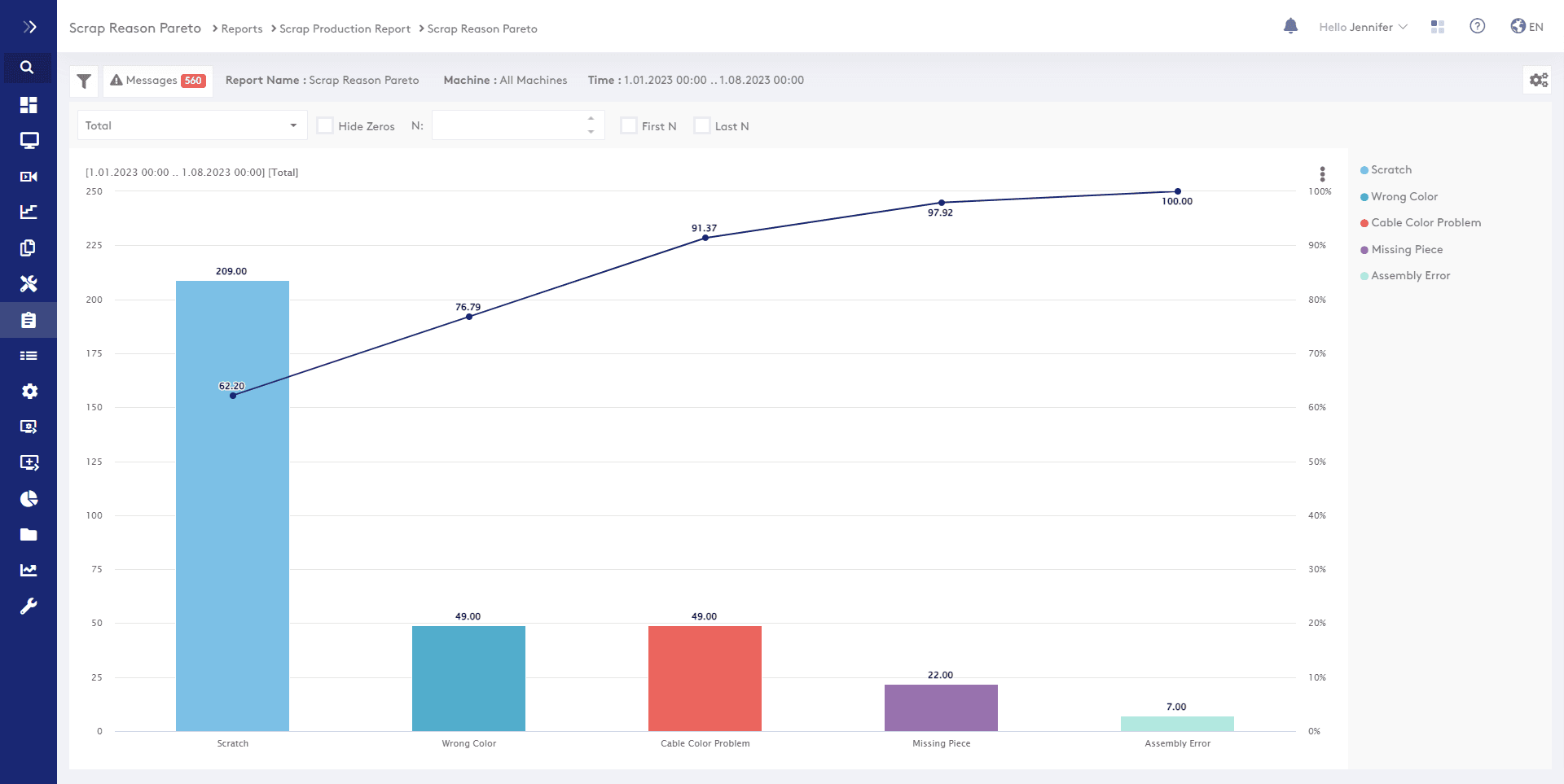
    Scrap Pareto

    Scrap Pareto

    Escalation Systems in Production

    The escalation system used in factories enables the rapid resolution of issues, which is critical for OEE improvements. This system defines who will be informed and who will take action when conditions arise that prevent operations from continuing as per defined standards.

    ProManage’s automatic escalation system visualizes problems such as speed reductions in machine operation in real-time, allowing businesses to take immediate action and minimize losses. Reducing response times through automation directly leads to decreased production losses and improved production capacity, ultimately enhancing OEE.

  • IMTS 2024’te ProManage Cloud’u Keşfedin!

    ProManage Cloud’u görmek için 9-14 Eylül 2024 tarihleri ​​arasında Chicago IL, McCormick Place’de East Building’in 3-135642 numaralı katındaki standımızı ziyaret edin ve üretim hacminizi ve makinelerinizin verimliliğini nasıl izleyebileceğinizi ve ProManage Cloud’u kullanarak operasyonlarınızı kolayca iyileştirmek için hangi eylemleri gerçekleştirebileceğinizi öğrenin.

    • Doğu Binası, Şikago, McCormick Place

    •  3.Kat, Stand #135642

  • Discover ProManage Cloud at International Manufacturing Technology Show 2024!

    Visit our Booth on Level 3 – Booth #135642 at the East Building to explore ProManage Cloud during IMTS 2024, taking place on September 9–14, 2024 at McCormick Place, Chicago, IL. Discover how you can easily monitor the production volume and efficiency of your machines, identify operational bottlenecks, and take fast action to improve your manufacturing performance with ProManage Cloud. 📍 East Building, McCormick Place, Chicago 🔍 Level 3, Booth #135642
  • Yenilemeli Bakım Anlaşmasının Avantajları Nelerdir?

    Endüstriyel üretim süreçlerinde sürdürülebilirlik ve verimlilik, işletmelerin başarısında kritik rol oynar. Bu bağlamda, MES (Manufacturing Execution Systems) ve MOM (Manufacturing Operations Management) sistemleri, üretim süreçlerinin optimize edilmesine yardımcı olurken, bakım anlaşmaları da bu sistemlerin uzun vadeli performansını güvence altına almak için önemli bir araçtır. Bu yazımızda, ProManage’in sunduğu yenilemeli bakım anlaşmasının avantajlarına odaklanacağız. ProManage’in bakım anlaşması, üretim sistemlerini güncel tutarak yeniliklerden faydalanmayı sağlar, danışmanlık hizmetleri sunar ve risk yönetimini etkin bir şekilde gerçekleştirir. Şimdi, bu bakım anlaşmasının işletmelere sağladığı avantajları detaylı bir şekilde inceleyelim.

    MES / MOM Sistemlerinde Yenilemeli Bakım Anlaşmasının Avantajları Nelerdir?

    Bir işletmede sistemin sürdürülebilirliğini sağlamak için bakım anlaşması zorunluluktur. ProManage üretim yönetim sisteminin uzun vadeli sürdürülebilirliği ve sistemden en yüksek düzeyde fayda sağlanabilmesi için yenilemeli bakım anlaşması kapsamında yeniliklerin yayınlanması, işletmelere danışmanlık hizmetleri ve risk yönetimi sunulmaktadır. ProManage bakım anlaşması sayesinde; üretim  sistemi güncel kalırken, işletme yeniliklerden ve danışmanlık hizmetlerinden faydalanır ve bu sayede üretim sistemindeki risklerin yönetimini sağlanarak proaktif bakım gerçekleştirmektedir.

    ProManage Yenilemeli Bakım Anlaşması ile Yeniliklerin Yayınlanması

    ProManage üretim yönetim sistemi sürekli olarak inovasyon ekibimiz tarafından geliştirilmekte ve sisteme yeni işlevler kazandırılmaktadır. Gelişen teknolojilere göre yenilenmiş sistemin, müşterilerimizde de güncel kalması için ProManage yenilemeli bakım anlaşması kapsamında yılda 4 kez periyodik güncelleme yapılarak yenilikler yaygınlaştırılmaktadır. Eklenen bu yeni özelliklerin ve Ar-Ge faaliyetlerinin bir bölümü kazan-kazan felsefesi ile yürütülmektedir. Bu kazan-kazan felsefesi doğrultusunda müşterilerimizin ilettiği istekler değerlendirilmekte ve sistemin tümüne fayda sağlayacak isteklerden ilham alınarak Ar-Ge projeleri açılmaktadır. Uygulama hayata geçtiğinde ise isteği yapan firma ve diğer tüm müşterilerimiz bu geliştirmelerden ücretsiz olarak faydalanmaktadır.

    İşletme Danışmanlık Hizmetleri ve Serbest Mühendislik Günü

    Yenilemeli bakım anlaşması kapsamında olan Serbest Mühendislik Günü yani SMG günleriyle ProManage MES/MOM sistemini kullanan fabrika içindeki tüm birimlerin ortak katılımı ile en fazla fayda sağlanması hedeflenmektedir. İşletme danışmanlık hizmetleri kapsamında olan Serbest Mühendislik Günü, kullanıcıların yapmış olduğu ön çalışma doğrultusunda ProManage sistemi ile ilgili ihtiyaç ve beklentilerinin gözden geçirilmesi, sisteme eklenen yenilikler ve ek modüller hakkında bilgi verilmesinin yanı sıra, kullanıcıların kullanım deneyimini artırmak için sistem ve rapor eğitimleri verilmektedir. Bu bağlamda müşteri yorumları formu gönderilmekte ve sistemi kullanan tüm birimler olan planlama, üretim ve bakım bölümü, kullanım düzeylerini ve ihtiyaçlarını veya geliştirmek istediği alanları belirtmektedir. Bu bilgilere göre eğitime gelecek mühendis belirlenerek eğitim öncesi hazırlıklar yapılarak eğitim günü organize edilmektedir.

    ProManage ile Risk Yönetimi

    ProManage MES/MOM sistemleri ile üretim tesislerinin sürekli ve en yüksek performansta çalışabilmesi için risk yönetimi kapsamında proaktif bakım hizmetleri sunulmaktadır. Yenilemeli bakım anlaşması yapılan işletmelerde bir bakım döneminde aşağıdaki işlemler uzak erişim aracılığıyla uzman ekibimiz tarafından gerçekleştirilmektedir;

    • Net PC performans/Log kontrolü
    • Listeleme ve raporlama süre kontrolü
    • Oracle sunucu kontrolü
    • Oracle Veri Tabanı geçersiz nesne/görüntü kontrolü
    • Oracle parametreleri kontrolü
    • Oracle index derlemesi
    • Veri Tabanı performansını artırmak için veri temizliği.

    Bakım anlaşması doğrultusudna yapılan kontrollerde tespit edilen hatalar ve iyileştirilmesi gereken alanlarla ilgili ProManage tarafından rapor hazırlanmasının ardından bunlar işletmeyle paylaşılarak iyileştirici faaliyetler için gerekli aksiyonlar alınmakta ve doğru risk yönetimi sağlanmaktadır. Ayrıca Oracle veri tabanının çökmesi veya arızalanması gibi donanım kaynaklı beklenmedik bir durum oluştuğunda bakım anlaşması kapsamında sistemin kurtarılması veya yeniden Oracle kurulumu yapılarak en son yedek alınan zamana geri yüklenmesi sağlanmaktadır. Yeni çıkan yazılım ve donanım ürünlerinin deneme kullanımı olarak kurulması ve belirli bir süre ücretsiz olarak müşterilerimizin kullanımına sunulması ve ek teklif ve yazılım geliştirmelerinde belirli bir oranda indirim uygulanması bakım anlaşması kapsamında sunulan diğer hizmetledir.

    Sonuç olarak, ProManage’in yenilemeli bakım anlaşması, işletmelere sadece sistemlerinin güncel kalmasını sağlamakla kalmaz, aynı zamanda üretim süreçlerinin verimliliğini artırır ve riskleri proaktif bir şekilde yönetir. Yeniliklerin düzenli olarak uygulanması, danışmanlık hizmetlerinin sağlanması ve risk yönetimi uygulamaları, işletmelere büyük bir rekabet avantajı kazandırır. Bu nedenle, ProManage’in bakım anlaşması, üretim yönetim sistemlerinin sürdürülebilirliğini sağlamak ve operasyonel mükemmeliyeti hedeflemek isteyen işletmeler için vazgeçilmez bir araçtır. Yenilemeli bakım anlaşması ile işletmenizin sistemlerini en yüksek performansta tutarak, gelecekteki başarılarınıza sağlam bir temel oluşturabilirsiniz.

  • Online Periyodik ProManage Kullanıcı Eğitimleri 2. Dönemi Başlıyor

    2024 Yılı ProManage “KeyUser” Online Kullanıcı Eğitimine katılım için gerekli bilgiler :

    (Eğitim takvimini aşağıda bulacaksınız!)

    • Standart Bakım” anlaşması olan firmalarımız Eğitim takviminde bulunan “E” kodlu Eğitim paketlerine 1 kişi, “Genişletilmiş Bakım” anlaşması bulunan firmalar ise 2 kişi katılabilir.
    • Eğitim takvimindeki “F” kodlu eğitim paketleri tüm müşteri katılımcılarımıza ücretsiz olup, katılımcı sayısı sınırı yoktur.
    • Kayıt olmak istediğiniz eğitime, eğitim tarihinden 2 hafta önce kayıt olmalısınız.
    • Tüm kullanıcılarımıza “KeyUser Sınavı” için bilgilendirme gönderilir. Sınav sonucu 70 puan ve üzeri alan katılımcımıza başarı sertifikası verilir.
    • Eğitim takviminden planınıza uygun eğitimleri (önceden belirlediğiniz katılımcılarınız için) seçerek kaydınızı gerçekleştirebilirsiniz

    Üretim (Destek Kontak Kişisi) KeyUser’ınız bilgisi dahilinde kayıt taleplerin oluşturulmasını önemle rica ederiz,

    Kayıt işlemi ardından,onay aşaması sonrası ilgili kayıt olan kullanıcımızın Şirket E-Mail adresine Eğitim için tarafımızdan eğitim katılım linki iletilecektir.

    Not: Yenilemeli Bakım Anlaşması (YBA) olmayan kullanıcılarımız için,  “E” Kodlu  Eğitimler paket başına ücretlendirilecektir.

    Soru veya talepleriniz için mby@promanage.com  adresinden iletişime geçebilirsiniz.

  • Next-Gen MES System

    Embracing Manufacturing Excellence: ProManage Cloud Next-Gen MES Systemner

    In an era where technological advancements and market dynamics evolve at an unprecedented pace, manufacturers find themselves grappling with the dual challenges of escalating operational demands and the relentless pursuit of efficiency and innovation.

    Amidst this complex landscape, ProManage Cloud Next-Gen MES system emerges as a transformative force, designed to propel manufacturing enterprises towards heightened efficiency, reduced operational costs, and superior product quality. This groundbreaking solution embodies the nexus of real-time operational visibility, advanced analytical capabilities, seamless integration, and a scalable cloud-based infrastructure, establishing itself as the cornerstone for manufacturing excellence in the digital age.

    ProManage Cloud Next-Gen MES system is a testament to the transformative power of digitalization in the manufacturing sector. It offers an unparalleled real-time monitoring framework that empowers manufacturers to achieve an eagle-eyed view of their production processes. This capability is not merely about overseeing operations; it’s about unlocking actionable insights that drive decisionmaking, enhance productivity, and mitigate risks by preemptively addressing potential disruptions before they escalate into costly downtime. The system’s advanced analytics further augment this by dissecting vast data streams to unearth patterns, predict trends, and inform strategic adjustments, thereby optimizing performance and product quality.

  • 2024 Manufacturing Trends

    The manufacturing landscape is in a constant state of evolution, driven by technological advancements, evolving market demands, and the collective objectives of industry players. As we look ahead to 2024, a suite of transformative trends is poised to redefine the manufacturing ecosystem, presenting both challenges and opportunities for businesses striving to stay ahead of the curve.

    From the continued rise of smart factories to the heightened focus on sustainability and carbon neutrality, the manufacturing industry is undergoing a profound metamorphosis. Innovative technologies like artificial intelligence, virtual processes, and data-driven maintenance are becoming integral to driving efficiency, flexibility, and safety across operations. Simultaneously, manufacturers are grappling with supply chain reassessments, shifting customer dynamics, and the ongoing importance of reshoring.

    Against this backdrop, employee well-being and the need to meet increased demand with a decreased labor force have emerged as key priorities. The manufacturing trends of 2024 are a testament to the industry’s resilience and adaptability, as businesses navigate the unique landscape shaped by the lingering effects of the COVID-19 pandemic and the relentless march of technological progress.

    The Continued Rise of Smart Factories

    The manufacturing industry is poised to reach a tipping point in the widespread adoption of smart factory technologies. As older equipment is gradually phased out, newer machines equipped with advanced sensors and monitoring capabilities are becoming increasingly prevalent. Manufacturers are recognizing the compelling benefits of smart factory implementation, including more proactive and effective maintenance, greater insights into process efficiency, and a reduction in overall operating costs.

    The driving factors behind this trend are multifaceted. Firstly, the costs of aftermarket sensors and smart factory software continue to decline, making the investment more accessible for businesses of all sizes. Secondly, the competitive landscape is pushing manufacturers to keep pace with their peers who are already reaping the rewards of smart factory technologies. As the advantages of data analytics and seamless communication between machinery and central monitoring systems become more apparent, the impetus to embrace these innovations intensifies.

    Increased Focus on Sustainability and Carbon Neutrality

    Environmental, social, and governance (ESG) considerations are gaining paramount importance in the manufacturing industry. Driven by both regulatory requirements and customer preferences, manufacturers are placing a heightened emphasis on sustainable processes and the pursuit of carbon-neutral practices.

    This trend is manifesting in various ways, from meeting stringent sustainability criteria for government, municipal, and institutional contracts to adapting to ESG requirements from commercial customers. Manufacturers are recognizing the need to align their operations with the growing global focus on environmental stewardship and social responsibility. By embracing sustainable practices and carbon-neutral initiatives, businesses can not only fulfill their ethical obligations but also position themselves as industry leaders and capitalize on the growing demand for eco-friendly products and services.

    Artificial Intelligence and Virtual Processes

    The manufacturing sector is embracing a suite of transformative technologies, including artificial intelligence (AI), virtual reality (VR), and augmented reality (AR), to enhance efficiency, flexibility, and safety across their operations.

    Digital twins, machine learning, and AI-powered systems are enabling remote monitoring, servicing, and equipment operation, reducing the need for on-site personnel. With the advent of 5G networks, the bandwidth and speed necessary to transmit real-time data from connected devices to central servers have become a reality, further empowering manufacturers to leverage the power of virtual and remote processes.

    The proliferation of these technologies has given rise to the concept of “dark factories,” which are entirely automated facilities operated remotely. As AR and VR technologies continue to evolve, the prevalence of such advanced, virtual-centric manufacturing environments is expected to increase, redefining the traditional factory landscape.

    Data-Driven Maintenance as a Margin Enhancer

    The manufacturing industry’s reliance on sensors, remote monitoring, connected devices, and the Internet of Things (IoT) has been a recurring theme in recent years. However, the significance of these technologies has only intensified in 2024, as manufacturers seek to leverage data-driven maintenance strategies to enhance their bottom line.

    The emergence of 5G networks has provided the necessary bandwidth and speed to transmit a wealth of information from connected devices to central servers, enabling more effective predictive maintenance. By harnessing the power of data analytics, manufacturers can now identify potential issues before they manifest, reducing unplanned downtime and the associated financial burden.

    Predictive maintenance has become a crucial margin enhancer, particularly in the wake of the economic challenges posed by the COVID-19 pandemic. By proactively addressing equipment maintenance, manufacturers can minimize costly disruptions and optimize their operational efficiency, ultimately bolstering their profitability.

    Supply Chain Reassessment and Flexibility

    The supply chain disruptions experienced in the aftermath of the COVID-19 pandemic have left an indelible mark on the manufacturing industry. In 2024, the supply chain continues to be a prominent area of focus, as businesses strive to enhance flexibility, reliability, and value-preservation within their sourcing and distribution networks.

    Data-driven inventory management has emerged as a strategic approach to identify previously unknown supply chain efficiencies. By leveraging data analytics, manufacturers can more quickly adapt to the uncertainties of the supply chain landscape and work to minimize disruptions, which remain unpredictable in the current environment.

    The pursuit of supply chain resilience has also spurred a renewed emphasis on reshoring, with manufacturers recognizing the importance of doing business closer to home. What was once viewed as a lofty goal is now becoming a more feasible and necessary supply chain solution, evolving from a temporary response to a more conventional way of operating.

    Shifting Focus from B2B to B2C

    Advancements in technology and supply chain strategies are enabling manufacturers to reconsider their relationships with end consumers. Rather than relying solely on retailers or distributors as intermediaries, many companies are now exploring direct-to-consumer (D2C) sales channels, leveraging e-commerce and other innovative platforms to engage with their target audience.

    This shift from a business-to-business (B2B) to a business-to-consumer (B2C) model is driven by the growing prevalence of online shopping and the desire to forge more direct connections with customers. By bypassing traditional distribution channels, manufacturers can enhance their understanding of consumer preferences, optimize their product offerings, and capture a larger share of the value chain.

    As this trend gains momentum, manufacturers must adapt their marketing, sales, and customer service strategies to cater to the unique needs and expectations of the end consumer, fostering a more personalized and engaging brand experience.

    The Ongoing Importance of Reshoring

    The COVID-19 pandemic has underscored the vulnerabilities inherent in global supply chains, leading to a renewed emphasis on reshoring manufacturing operations. What was once considered a lofty goal has now become a necessary supply chain solution, as businesses seek to bolster continuity, quality, and fulfillment speed.

    Reshoring is no longer a temporary response to a crisis but rather a more permanent and conventional way of operating for manufacturers. By bringing production closer to their primary markets, businesses can mitigate the risks of supply chain disruptions, reduce lead times, and enhance their responsiveness to customer demands.

    Moreover, reshoring aligns with the growing consumer preference for products made closer to home, as it reinforces the values of quality, service, and local economic development. As manufacturers continue to navigate the evolving supply chain landscape, reshoring is poised to solidify its place as a strategic imperative for the industry.

    Employee Safety and Health: A Top Priority

    While employee safety and health have always been a primary concern in the manufacturing sector, the COVID-19 pandemic has thrust these issues into the spotlight, elevating them as a critical trend for 2024 and beyond.

    Manufacturers are adopting innovative approaches to monitor and maintain the well-being of their workforce, recognizing that the health and safety of their employees are not only essential for their workforce but also for the overall business performance. Some facilities are employing advanced equipment to track employee locations, movements, and even temperatures, enabling proactive management of injury risks and illness prevention.

    By prioritizing employee safety and well-being, manufacturers can foster a more engaged, productive, and loyal workforce, while also mitigating the financial and operational risks associated with workplace incidents and illnesses. This trend underscores the industry’s commitment to creating a safe and supportive work environment for its most valuable asset – its people.

    3D Printing: Transforming Maintenance and Customization

    The rapid advancements in 3D printing technology have positioned it as one of the most significant game-changers in the manufacturing industry. With improved accuracy, flexibility, and cost-effectiveness, 3D printing is poised to revolutionize various aspects of production and maintenance.

    One of the key benefits of 3D printing is its potential to streamline the maintenance and repair process. Technicians can now print replacement parts on-demand, drastically reducing the time required to source and procure these components from a warehouse. This ability to produce parts locally and on an as-needed basis can significantly minimize downtime, enhancing operational efficiency and productivity.

    Moreover, 3D printing enables greater customization and personalization of products, allowing manufacturers to cater to the unique preferences and requirements of their customers. This level of agility and responsiveness to market demands is crucial in an increasingly competitive landscape, where the ability to deliver tailored solutions can provide a distinct competitive advantage.

    As the capabilities of 3D printing continue to evolve, the manufacturing industry is poised to witness even more transformative applications of this technology in the years to come.

    Meeting Increased Demand with a Decreased Labor Force

    The manufacturing industry is facing a complex challenge – the need to meet growing demand for their products and services while navigating a shrinking labor force. This dynamic has compelled businesses to reevaluate their processes and identify innovative ways to increase efficiency and capacity without relying solely on a larger workforce.

    Manufacturers are undertaking a comprehensive evaluation of their operations, leveraging technology and automation to streamline processes and boost productivity. By identifying and addressing inefficiencies, they can optimize their output and fulfill the increasing demand, even with a reduced labor pool.

    Addressing the skills gap and providing cutting-edge technical training to the existing workforce have also become essential strategies. Upskilling and reskilling employees equips them with the necessary capabilities to operate and maintain the advanced technologies that are transforming the manufacturing landscape.

    As the industry grapples with labor shortages, the ability to do more with less has become a critical imperative. Manufacturers that can successfully navigate this challenge will be well-positioned to thrive in the evolving manufacturing landscape of 2024 and beyond.

    The Convergence of Trends: A Holistic Approach

    The manufacturing trends of 2024 are not isolated phenomena but rather interconnected elements of a broader transformation. The continued rise of smart factories, the focus on sustainability and carbon neutrality, the embrace of artificial intelligence and virtual processes, and the emphasis on data-driven maintenance all work in concert to drive efficiency, flexibility, and resilience across the industry.

    Similarly, the reassessment of supply chains, the shift towards direct-to-consumer models, and the ongoing importance of reshoring are all manifestations of the industry’s efforts to enhance its responsiveness to market dynamics and customer preferences.

    Underpinning these trends is a fundamental commitment to employee well-being and the recognition that a skilled, engaged, and safe workforce is essential for sustained success. The integration of technologies like 3D printing further reinforces the industry’s ability to meet increased demand with a decreased labor force, optimizing operations and unlocking new avenues for growth.

    By adopting a holistic approach that leverages the synergies between these trends, manufacturers can position themselves for long-term success in the rapidly evolving landscape of 2024 and beyond.

    Embracing the Future: Strategies for Navigating the Trends

    As the manufacturing industry navigates the transformative trends of 2024, businesses must develop comprehensive strategies to capitalize on the opportunities and mitigate the challenges presented by this dynamic landscape.

    First and foremost, manufacturers must prioritize the adoption of smart factory technologies, leveraging data analytics and seamless communication between machinery and central monitoring systems. By embracing the full potential of these innovations, they can drive proactive maintenance, enhance process efficiency, and reduce operational costs.

    Simultaneously, manufacturers must align their operations with the growing emphasis on sustainability and carbon neutrality. Investing in eco-friendly processes, renewable energy sources, and circular economy initiatives can not only fulfill regulatory and customer demands but also position the business as an industry leader.

    Harnessing the power of artificial intelligence, virtual reality, and augmented reality can enable remote monitoring, servicing, and equipment operation, fostering greater flexibility and safety across the manufacturing ecosystem. Coupling these technologies with robust data-driven maintenance strategies can further enhance productivity and profitability.

    Addressing supply chain vulnerabilities and embracing reshoring as a strategic imperative can bolster the resilience and responsiveness of the business, mitigating the risks of disruptions and ensuring timely fulfillment of customer orders.

    As manufacturers navigate the shift towards direct-to-consumer models, they must adapt their marketing, sales, and customer service approaches to deliver a personalized and engaging brand experience that caters to the evolving needs of end consumers.

    Underpinning all of these strategies is the critical importance of investing in employee safety, health, and skill development. By fostering a safe, supportive, and technologically-adept workforce, manufacturers can unlock new levels of productivity, innovation, and long-term sustainability.

    The manufacturing trends of 2024 represent a pivotal moment in the industry’s evolution, as businesses navigate a landscape shaped by technological advancements, evolving market demands, and the lingering effects of the COVID-19 pandemic. From the continued rise of smart factories to the heightened focus on sustainability and carbon neutrality, the industry is undergoing a profound transformation.

    By embracing innovative technologies, optimizing supply chain strategies, and prioritizing employee well-being, manufacturers can position themselves for success in the years to come. The ability to seamlessly integrate these trends into a holistic, forward-looking approach will be the hallmark of the industry’s most resilient and adaptable players.

    As the manufacturing sector continues to evolve, the ability to anticipate and adapt to the trends of 2024 and beyond will be the key to unlocking new levels of efficiency, flexibility, and growth. By staying at the forefront of these transformative changes, manufacturers can navigate the future with confidence and cement their place as leaders in the ever-changing landscape of the industry.
  • How to get the right MES software

    In today’s rapidly evolving manufacturing landscape, the ability to streamline operations, enhance productivity, and maintain quality control is paramount. One innovative solution that has gained significant traction is the Manufacturing Execution System (MES) – a powerful tool that bridges the gap between an organization’s planning and control systems, transforming the factory floor into a well-oiled, data-driven machine. As manufacturers grapple with increasingly complex production workflows, rising customer demands, and the need for greater operational agility, the right MES software can be the key to unlocking a new era of manufacturing excellence. However, with a myriad of MES solutions available, the task of selecting the most suitable option for your organization can be daunting. In this comprehensive guide, we’ll delve into the essential considerations, best practices, and expert insights to help you navigate the MES software selection process with confidence. Whether you’re a seasoned manufacturing veteran or embarking on your first MES implementation, this article will equip you with the knowledge and strategies to make an informed decision that aligns with your unique business objectives and operational needs.

    Understanding the Transformative Role of MES

    The Brains of the “Smart Factory” At the heart of the “smart factory” lies the Manufacturing Execution System (MES), a pivotal software solution that connects an organization’s enterprise-level planning and control systems (such as ERP) with the real-time operations on the factory floor. By gathering data from machines, sensors, operators, and other Industrial Internet of Things (IIoT) devices, MES systems provide accurate, up-to-date insights into the status of production activities, enabling stakeholders to monitor operations, address bottlenecks, reduce downtime and rework, and make well-informed decisions in a timely manner. Optimizing Manufacturing Processes MES software is designed to facilitate the seamless management and control of manufacturing processes, from production planning and scheduling to quality assurance and compliance. By automating tasks, streamlining workflows, and offering real-time feedback, these systems can significantly enhance plant floor efficiency and productivity. Moreover, MES solutions play a crucial role in inventory management, ensuring efficient resource allocation, workload balancing, and on-time deliveries – all of which contribute to improved profitability. Additionally, they support the measurement of overall equipment effectiveness (OEE), a critical metric for gauging manufacturing efficiency and identifying areas for continuous improvement. Driving Data-Driven Decision-Making One of the key advantages of MES software is its ability to provide organizations with comprehensive and accurate production data, enabling data-driven decision-making to enhance business processes and optimize resource utilization. By tracking and documenting the real-time transformation of raw materials into finished products, MES systems offer valuable insights that can inform strategic planning, process optimization, and quality control initiatives.

    Recognizing the Triggers for MES Implementation

    Implementing an MES solution is not a one-size-fits-all proposition; the right time to do so depends on the specific needs and circumstances of each organization. However, there are several key indicators that can suggest the appropriate time to consider an MES investment:

    Increasing Complexity in Manufacturing Processes

    As your manufacturing operations become more intricate and challenging to manage manually, an MES can help streamline manufacturing operations management, increase efficiency, and reduce errors. The implementation of an MES can be particularly beneficial when your company experiences growth and expansion, as it provides the necessary tools for managing larger and more complex production workflows.

    Inefficiencies, Bottlenecks, and Quality Challenges

    If your production processes are plagued by inefficiencies, bottlenecks, quality control challenges, or compliance issues, an MES can be a game-changer. By providing real-time data and performance analysis across production lines, these systems can help you identify and address these problems promptly, leading to improved overall efficiency and product quality.

    The Need for Greater Visibility and Control

    As manufacturing operations become more complex, the demand for real-time visibility and control over production processes increases. An MES system can empower stakeholders to monitor operations, address issues, and make well-informed decisions in a timely manner, ultimately enhancing the overall effectiveness of your manufacturing operations.

    Preparing for Future Growth and Expansion

    If your company is poised for future growth and expansion, implementing an MES can be a strategic move. These systems are designed to scale with your business, providing the necessary tools and capabilities to manage larger and more complex production workflows as your organization evolves. By carefully considering these key triggers, you can determine the optimal time to invest in an MES solution and position your manufacturing operations for long-term success.

    Defining Your MES Software Requirements

    Selecting the right MES software is a critical decision that requires a thorough assessment of your manufacturing operations, clear objective-setting, and the involvement of key stakeholders. To ensure a successful MES implementation and maximize its benefits, follow these steps:

    Assess Your Manufacturing Processes and Workflows

    Begin by conducting a comprehensive analysis of your manufacturing processes, workflows, and key performance indicators (KPIs). Identify the specific areas where you need improvement, such as inventory management, product quality, traceability, or production scheduling. Involve relevant stakeholders, including production managers, IT personnel, and quality control teams, to gather a complete understanding of your requirements.

    Determine Your Specific Needs and Objectives

    Based on your assessment, clearly define the objectives you aim to achieve through the implementation of an MES system. These objectives might include enhancing production efficiency, improving quality control, ensuring regulatory compliance, or optimizing inventory management. By setting specific, measurable goals, you can better evaluate the suitability of different MES solutions and ensure that the selected software aligns with your business needs.

    Prioritize Key Functionalities and Features

    Identify the core functionalities and features that are essential for your manufacturing operations. This might include real-time production monitoring, predictive maintenance, quality assurance, inventory tracking, or advanced analytics and reporting capabilities. Prioritize these features based on their importance to your organization, as this will guide your vendor research and selection process.

    Consider Integration and Scalability Requirements

    Assess the integration capabilities of the MES software, ensuring that it can seamlessly connect with your existing systems, such as ERP, SCADA, and other relevant manufacturing software. Additionally, consider the scalability of the MES solution, as your business may grow and evolve over time, requiring the system to adapt to changing requirements without major disruptions.

    Involve Key Stakeholders

    Engage with relevant stakeholders throughout the MES selection process, including production managers, IT professionals, quality control teams, and upper-level management. Their input and buy-in will be crucial for a successful implementation, as they will be the primary users of the system and can provide valuable insights into the specific needs and challenges of your organization. By thoroughly defining your MES software requirements, you can increase the chances of selecting a solution that aligns with your business objectives and contributes to the long-term success of your manufacturing operations.

    Conducting Comprehensive Vendor Research

    With a clear understanding of your MES requirements, the next step is to conduct thorough research on potential vendors and their offerings. This process will help you identify the most suitable MES software for your organization and ensure a successful implementation.

    Evaluate Vendor Credentials and Industry Experience

    Begin your vendor research by assessing the credentials and industry experience of the MES software providers. Look for vendors with a proven track record of successful implementations, particularly in your specific industry. Review case studies, customer testimonials, and online reviews to gauge their reputation and the level of satisfaction among their existing clients.

    Assess Scalability, Flexibility, and Customization Capabilities

    Evaluate the scalability and flexibility of the MES software, ensuring that it can adapt to your evolving business needs and manufacturing processes. Assess the vendor’s ability to customize the system to your specific requirements, as this can be a crucial factor in ensuring a seamless integration and optimal performance.

    Prioritize User-Friendliness and Mobile Accessibility

    In today’s dynamic manufacturing environment, it’s essential to consider the user-friendliness and mobile accessibility of the MES software. Evaluate the intuitiveness of the user interface, the ease of navigation, and the availability of mobile capabilities that allow supervisors and operators to monitor and manage production from anywhere on the shop floor.

    Examine Integration and Data Analytics Capabilities

    Ensure that the MES software can seamlessly integrate with your existing systems, such as ERP, SCADA, and other relevant manufacturing software. Additionally, assess the data analytics and reporting capabilities of the MES solution, as these features will be instrumental in driving data-driven decision-making and continuous process improvement.

    Evaluate Compliance, Security, and Support

    For industries with strict regulatory requirements, such as pharmaceuticals or aerospace, ensure that the MES software complies with the relevant standards and provides robust security measures to protect sensitive data. Also, consider the level of support provided by the vendor during and after the implementation, as well as the availability of training resources for your team.

    Conduct Proof of Concept and Site Visits

    Before making a final decision, consider running a proof of concept (PoC) with the shortlisted MES software to assess its suitability for your specific manufacturing environment. Additionally, reach out to the vendor’s existing clients to get feedback on their experiences and, if possible, conduct site visits to observe the software in action and understand its impact on manufacturing processes. By following these steps and taking the time to thoroughly evaluate your options, you can increase the chances of selecting an MES software that aligns with your business objectives and contributes to the long-term success of your manufacturing operations.

    Integrating MES with Enterprise Asset Management (EAM)

    While a Manufacturing Execution System (MES) is a crucial component of digital transformation for manufacturers, it is often just one piece of the puzzle. To truly unlock the full potential of your MES investment, it’s essential to integrate it with an Enterprise Asset Management (EAM) or Asset Performance Management (APM) platform.

    Leveraging the Power of Enterprise-Wide Integration

    By integrating your MES software with an EAM or APM solution, you can create a seamless, enterprise-wide ecosystem that connects your manufacturing operations with broader asset management strategies. This integration allows you to leverage data from multiple sources, providing a comprehensive view of your manufacturing processes, asset performance, and overall business performance.

    Enhancing Operational Reliability and Performance

    The integration of MES and EAM/APM enables manufacturers to improve operational reliability and performance. By combining real-time production data from the MES with asset-related information, such as maintenance history and condition monitoring, you can make more informed decisions about asset management, predictive maintenance, and production optimization.

    Reducing Risk and Ensuring Compliance

    The integrated MES-EAM/APM platform can also help manufacturers reduce operational risk and ensure compliance with industry regulations. By centralizing data and streamlining workflows, these systems can provide robust traceability, documentation, and audit capabilities – essential for industries with strict regulatory requirements.

    Maximizing Return on Investment (ROI)

    The synergies created by integrating MES and EAM/APM can lead to significant improvements in overall equipment effectiveness (OEE), reduced downtime, and enhanced resource utilization. These benefits translate into tangible financial gains, enabling manufacturers to maximize the return on their investment in these critical software solutions.

    Ensuring a Successful MES Implementation

    Implementing a Manufacturing Execution System (MES) is a strategic initiative that requires careful planning, stakeholder engagement, and a structured approach to ensure a successful outcome. Here are the key steps to guide you through the MES implementation process:

    Develop a Comprehensive Implementation Plan

    Begin by creating a detailed implementation plan that outlines the project scope, timeline, resource requirements, and key milestones. Identify the critical success factors, potential risks, and mitigation strategies to ensure a smooth transition. Assign clear roles and responsibilities to the project team, and establish effective communication channels with all stakeholders.

    Engage Key Stakeholders and End-Users

    Involve key stakeholders, including production managers, IT personnel, quality control teams, and end-users, throughout the implementation process. Ensure that their requirements and concerns are addressed, and provide comprehensive training to prepare them for the transition to the new MES system.

    Ensure Seamless Integration with Existing Systems

    Prioritize the integration of the MES software with your existing enterprise systems, such as ERP, SCADA, and other manufacturing software. Carefully plan and execute the data migration process to ensure the seamless flow of information across the organization.

    Implement a Phased Rollout Approach

    Consider a phased rollout approach, where you implement the MES in a controlled, step-by-step manner, rather than a “big bang” deployment. This allows you to address any issues or challenges that arise during the initial implementation, and gradually build confidence and buy-in among your workforce.

    Establish Robust Data Management and Analytics

    Develop a comprehensive data management strategy to ensure the integrity, security, and accessibility of the data generated by the MES system. Leverage the advanced analytics and reporting capabilities of the MES to drive data-driven decision-making and continuous process improvement.

    Provide Ongoing Training and Support

    Invest in comprehensive training programs to equip your team with the knowledge and skills necessary to effectively operate and maintain the MES system. Additionally, ensure that you have access to reliable technical support from the vendor, both during and after the implementation phase.

    Continuously Monitor and Optimize Performance

    Regularly monitor the performance of the MES system, track key performance indicators, and identify opportunities for optimization. Leverage the system’s feedback and analytics to make data-driven adjustments and continuously enhance the efficiency and effectiveness of your manufacturing operations. By following these best practices, you can increase the chances of a successful MES implementation and unlock the full potential of this transformative technology within your manufacturing organization.

    Realizing the Benefits of MES: A Closer Look

    The implementation of a robust Manufacturing Execution System (MES) can deliver a wide range of benefits that positively impact your manufacturing operations, productivity, and overall business performance. Let’s explore these advantages in greater detail:

    Streamlined Production Processes

    MES software helps streamline and automate manufacturing processes, from production planning and scheduling to quality assurance and compliance. By eliminating manual tasks and optimizing workflows, these systems can significantly enhance efficiency, reduce errors, and improve overall throughput.

    Improved Inventory Management

    MES solutions play a crucial role in effective inventory management, ensuring efficient resource allocation, workload balancing, and on-time deliveries. By providing real-time visibility into material movements and stock levels, these systems can help manufacturers minimize inventory-related costs and improve supply chain reliability.

    Enhanced Quality Control and Compliance

    MES software helps enforce quality control procedures, monitor key performance metrics, and capture real-time data. This enables manufacturers to maintain strict quality standards, ensure regulatory compliance, and quickly identify and address any quality issues that may arise.

    Increased Operational Visibility and Control

    By gathering data from various sources, including machines, sensors, and operators, MES systems provide stakeholders with real-time visibility and control over production activities. This empowers decision-makers to monitor operations, address bottlenecks, and make well-informed decisions in a timely manner.

    Data-Driven Decision-Making

    MES solutions generate comprehensive and accurate production data, enabling manufacturers to leverage data-driven insights for continuous process improvement. These insights can inform strategic planning, optimize resource utilization, and drive the development of innovative products and services.

    Improved Overall Equipment Effectiveness (OEE)

    MES software supports the measurement and optimization of overall equipment effectiveness (OEE), a critical metric that helps manufacturers identify and address the root causes of production losses. By improving OEE, organizations can enhance their productivity, reduce downtime, and increase profitability.

    Enhanced Traceability and Genealogy

    Many MES systems offer advanced traceability and genealogy capabilities, which are essential for industries facing strict regulations. These features enable manufacturers to track the movement of materials and processes throughout the smart manufacturing lifecycle, ensuring compliance and facilitating effective product recalls, if necessary. By leveraging the powerful capabilities of MES software, manufacturers can unlock a new era of operational efficiency, quality control, and data-driven decision-making – ultimately driving sustainable growth and competitive advantage in the ever-evolving manufacturing landscape.

    Overcoming Common MES Implementation Challenges

    While the benefits of implementing a Manufacturing Execution System (MES) are substantial, the journey to a successful implementation is not without its challenges. Recognizing and addressing these potential obstacles can be the key to ensuring a smooth and effective MES deployment.

    Resistance to Change

    One of the primary challenges faced during MES implementation is the resistance to change among the workforce. Employees may be hesitant to adapt to new technologies and processes, which can hinder the adoption and effective utilization of the MES system. To overcome this, it’s essential to involve end-users in the implementation process, provide comprehensive training, and foster a culture of continuous learning and improvement.

    Data Integration and Compatibility Issues

    Seamlessly integrating the MES with existing enterprise systems, such as ERP and SCADA, can be a complex and time-consuming task. Compatibility issues, data quality concerns, and the need for data migration can all present challenges during the implementation Overcoming these integration challenges requires careful planning, thorough testing, and close collaboration between IT and operational teams. Establishing clear data governance policies and investing in robust data management strategies can help ensure the successful integration of the MES with other enterprise systems.

    Lack of Organizational Alignment

    Successful MES implementation requires alignment across various departments, from production to quality control to IT. If there is a lack of cross-functional collaboration and a shared understanding of the project’s objectives, the implementation can face significant roadblocks. To mitigate this, it’s crucial to engage all relevant stakeholders, clearly communicate the benefits of the MES, and foster a culture of teamwork and shared accountability.

    Budget and Resource Constraints

    Implementing an MES can be a significant investment, and organizations may face budget and resource constraints that can hinder the project’s progress. To address this challenge, it’s essential to develop a comprehensive cost-benefit analysis, prioritize the most critical functionalities, and explore financing options or phased deployment strategies that align with the available resources.

    Scalability and Flexibility Concerns

    As manufacturing operations evolve and business requirements change, the MES system must be able to scale and adapt accordingly. Failing to consider the long-term scalability and flexibility of the MES solution can lead to costly system upgrades or replacements in the future. During the vendor selection process, ensure that the MES software can accommodate your organization’s growth and changing needs without major disruptions.

    Lack of Ongoing Support and Maintenance

    Successful MES implementation is not a one-time event; it requires ongoing support, maintenance, and optimization to ensure the system continues to meet the organization’s needs. Inadequate training, limited technical support, or a lack of internal expertise can hinder the effective use and maintenance of the MES system. To address this, allocate resources for continuous training, establish a strong partnership with the MES vendor, and develop in-house expertise to manage the system effectively. By anticipating and addressing these common MES implementation challenges, organizations can increase the chances of a successful deployment, unlock the full potential of their MES investment, and drive sustainable improvements in their manufacturing operations.

    Maximizing the Impact of MES: Real-World Success Stories

    The transformative impact of Manufacturing Execution Systems (MES) is not just a theoretical concept; it has been demonstrated time and again in real-world manufacturing environments. Let’s explore a few success stories that showcase the tangible benefits of MES implementation:

    Improving Quality and Compliance in the Pharmaceutical Industry

    A leading pharmaceutical manufacturer faced ongoing challenges with quality control and regulatory compliance. By implementing a comprehensive MES solution, the company was able to enforce strict quality control procedures, monitor critical quality metrics in real-time, and ensure seamless traceability of their production processes. As a result, the organization significantly reduced the number of product recalls, improved overall quality, and maintained full compliance with industry regulations.

    Enhancing Production Efficiency in Automotive Manufacturing

    A major automotive manufacturer struggled with inefficient production processes, leading to increased downtime and missed delivery targets. By deploying an MES system, the company was able to optimize production planning and scheduling, streamline workflows, and leverage real-time data analytics to identify and address bottlenecks. This transformation led to a 20% increase in overall equipment effectiveness (OEE), a 15% reduction in production lead times, and a marked improvement in on-time deliveries to their customers.

    Driving Inventory Optimization and Supply Chain Visibility

    A global electronics manufacturer faced challenges with inventory management and supply chain visibility, resulting in frequent stockouts and production delays. The implementation of an MES solution equipped the company with advanced inventory tracking capabilities, enabling them to optimize material movements, minimize excess stock, and improve supply chain responsiveness. This, in turn, led to a 30% reduction in inventory-related costs and a significant improvement in the organization’s ability to meet customer demand.

    Fostering Data-Driven Decision-Making in Aerospace Manufacturing

    An aerospace manufacturer sought to enhance its decision-making processes and drive continuous improvement across its operations. By integrating an MES system with their existing enterprise-level systems, the company was able to gather comprehensive production data, analyze performance trends, and identify opportunities for optimization. This data-driven approach empowered the organization to make more informed decisions, implement targeted process improvements, and achieve a 12% increase in overall productivity. These real-world success stories demonstrate the tangible benefits that manufacturers can realize through the strategic implementation of a robust MES system. By addressing their unique challenges and aligning the MES with their specific business objectives, these organizations have been able to transform their manufacturing operations, enhance productivity, and strengthen their competitive position in the market.

    Embracing the Future of Manufacturing with MES

    In the ever-evolving landscape of modern manufacturing, the Manufacturing Execution System (MES) has emerged as a transformative technology that can unlock new levels of operational efficiency, quality control, and data-driven decision-making. By bridging the gap between enterprise-level planning and the realities of the factory floor, MES solutions empower manufacturers to streamline processes, enhance productivity, and maintain a competitive edge. As you embark on your journey to select and implement the right MES software for your organization, remember the key considerations outlined in this comprehensive guide. From thoroughly assessing your manufacturing requirements and conducting thorough vendor research to ensuring a successful implementation and leveraging the synergies of enterprise-wide integration, each step is crucial in maximizing the impact of your MES investment. By embracing the power of MES, you can position your manufacturing operations for long-term success, adapting to changing market demands, optimizing resource utilization, and driving continuous improvement. As the manufacturing industry continues to evolve, the strategic deployment of MES will be a pivotal factor in separating industry leaders from laggards. Embark on your MES journey with confidence, and unlock the full potential of your manufacturing capabilities. The future of your organization’s success may very well depend on it.
  • Relationship Between OEE and MES

    Manufacturing excellence is a constantly evolving pursuit, with organizations continuously seeking ways to enhance productivity, reduce waste, and drive continuous improvement. At the heart of this quest lies the powerful combination of Overall Equipment Effectiveness (OEE) and Manufacturing Execution Systems (MES) – two complementary tools that can unlock unprecedented operational efficiency.

    OEE is a widely recognized key performance indicator (KPI) that provides a comprehensive view of a manufacturing process’s overall effectiveness. It encompasses three critical factors: availability, performance, and quality. By distilling these elements into a single, easy-to-understand metric, OEE empowers manufacturers to identify and address their most pressing operational challenges.

    On the other hand, MES is a robust software solution that integrates and streamlines various aspects of the manufacturing process, from production planning and scheduling to quality control and maintenance. MES serves as the digital backbone, providing real-time visibility and control over the entire manufacturing ecosystem.

    The synergy between OEE and MES is undeniable. While OEE offers a holistic assessment of a process’s efficiency, MES provides the necessary tools and data to drive continuous improvement. By seamlessly integrating these two powerful concepts, manufacturers can unlock a deeper understanding of their operations, identify areas for optimization, and implement targeted strategies to enhance overall equipment effectiveness.

    Leveraging OEE for Continuous Improvement

    The foundation of OEE lies in its ability to provide a clear and concise measure of a manufacturing process’s performance. By breaking down availability, performance, and quality into measurable components, OEE empowers manufacturers to pinpoint the root causes of inefficiencies and take corrective actions.

    Availability: Addressing Downtime Challenges

    Availability, the first pillar of OEE, focuses on the ratio of actual production time to planned production time. Tracking and analyzing downtime is a crucial step in improving availability. By identifying the top reasons for process interruptions, manufacturers can address the low-hanging fruit and gradually work towards optimizing their operations.

    Performance: Enhancing Productivity

    Performance, the second component of OEE, examines the speed at which a process operates compared to its designed or ideal speed. Identifying and addressing factors that impact production rates, such as equipment issues, process bottlenecks, or operator training gaps, can lead to significant performance improvements.

    Quality: Reducing Defects and Waste

    The final element of OEE, quality, reflects the proportion of units produced that meet the required standards. By tracking and analyzing quality-related data, manufacturers can pinpoint the sources of defects, implement robust quality control measures, and minimize the costly impact of rework and scrap.

    Integrating MES for Comprehensive Visibility and Control

    While OEE provides the overarching framework for understanding manufacturing efficiency, MES serves as the essential tool for data collection, analysis, and process optimization. By seamlessly integrating these two systems, manufacturers can unlock a wealth of insights and drive continuous improvement.

    Real-time Data Monitoring and Reporting

    MES systems are designed to capture and analyze real-time data from various sources across the manufacturing environment. This comprehensive data collection enables manufacturers to gain a deeper understanding of their processes, identify bottlenecks, and make informed decisions to enhance OEE.

    Automated Downtime Tracking and Root Cause Analysis

    One of the key functionalities of MES is its ability to track downtime events and categorize them according to specific reasons, such as equipment failures, process issues, or operator errors. This granular data, coupled with advanced analytics, empowers manufacturers to uncover the root causes of downtime and implement targeted solutions.

    Predictive Maintenance and Proactive Optimization

    MES systems can also integrate with condition-monitoring sensors and predictive maintenance algorithms to anticipate equipment failures and schedule proactive maintenance. By combining this predictive capability with OEE insights, manufacturers can optimize their maintenance strategies, reduce unplanned downtime, and improve overall equipment reliability.

    Quality Control and Compliance Assurance

    Ensuring consistent product quality is a critical aspect of manufacturing excellence. MES systems provide robust quality control features, such as real-time monitoring, statistical process control, and automated quality checks. By integrating these capabilities with OEE metrics, manufacturers can enhance their quality management practices and ensure compliance with industry standards.

    Driving Continuous Improvement with OEE and MES

    The synergistic relationship between OEE and MES empowers manufacturers to embark on a continuous improvement journey, unlocking new levels of operational efficiency and profitability.

    Establishing a Data-driven Culture

    By seamlessly integrating OEE and MES, manufacturers can foster a data-driven culture, where decision-making is based on factual insights rather than assumptions. This shift towards data-driven operations enables more informed and targeted improvements, leading to sustainable performance enhancements.

    Aligning Organizational Goals and Strategies

    The comprehensive visibility provided by the OEE-MES integration allows manufacturers to align their operational strategies with broader organizational goals. This alignment ensures that improvement efforts are focused on the areas that deliver the greatest impact, ultimately driving long-term business success.

    Fostering a Culture of Continuous Improvement

    The continuous feedback loop created by the OEE-MES integration encourages a culture of continuous improvement within the organization. By regularly reviewing OEE metrics, identifying areas for optimization, and implementing targeted improvements through the MES platform, manufacturers can foster a mindset of ongoing refinement and innovation.

    The powerful combination of OEE and MES is a game-changer for manufacturers seeking to optimize their operations and drive continuous improvement. By leveraging the synergies between these two complementary tools, organizations can unlock unprecedented levels of efficiency, quality, and productivity. As the manufacturing landscape continues to evolve, the OEE-MES integration will remain a crucial enabler of success, empowering manufacturers to stay ahead of the curve and maintain their competitive edge.

  • Fair: Automate Show 2024

    We are exhibiting at Automate Show 2024 with our smart manufacturing solutions!

    Experience firsthand our state-of-the-art MES and smart factory solutions, interactive demonstrations, personalized consultations, and much more! Join us at the Automate Show in Chicago from May 6th to 9th and explore our solutions to unlock an innovative future.

    McCormick Place, Chicago, Illinois, 60616.
    Booth #1816

    Let’s lead the way to creativity, sustainability, and next-generation manufacturing excellence together.