promanage.testmagna.com

Author: yonetici

  • Yapay Zeka Destekli Kestirimci Bakım: Arızalar Oluşmadan Durdurmak Mümkün mü?

    Endüstriyel üretimde beklenmeyen arızalar, yalnızca maliyetleri artırmakla kalmaz; aynı zamanda operasyonel sürekliliği de ciddi şekilde riske atar. Ancak günümüzde yapay zeka üretim teknolojilerinin gelişmesiyle birlikte bu riskleri önceden öngörmek artık mümkün hale gelmiştir. Kestirimci bakım yaklaşımı da tam bu noktada devreye girerek makinelerin gerçek zamanlı verilerle izlenmesini sağlar ve arızalar oluşmadan müdahale imkanı sunar. Bu yazımızda, AI tabanlı MES sistemleri ile bakım süreçlerinin nasıl dönüşüm geçirdiğini ve işletmelere sağladığı stratejik avantajları ele alıyoruz.

    Bakım Stratejilerinde Evrim: Arıza Sonrası Bakımdan Kestirimci Bakıma

    Endüstriyel bakım stratejileri; reaktif, önleyici ve son olarak kestirimci olmak üzere üç ana aşamadan geçmiştir. Reaktif modelde arıza oluştuktan sonra müdahale edilirken, önleyici modelde makinenin durumuna bakılmaksızın periyodik takvimler izlenir. Ancak bu iki model de ya plansız duruş riskini ya da gereksiz bakım maliyetlerini beraberinde getirir.

    Kestirimci bakım ise makinenin gerçek sağlık durumunu sürekli izleyerek sadece ihtiyaç duyulan anda müdahaleyi öngörür. Bu stratejik geçiş, özellikle AI tabanlı MES altyapılarının sahadaki veriyi işleme kabiliyetiyle mümkün olmaktadır. Doğru bir arıza tahmini mekanizması sayesinde bakım ekipleri, üretim planını aksatmayacak en uygun zaman dilimini belirleyebilir. Bu sayede elde edilen kestirimci bakım avantajları, işletmenin operasyonel çevikliğini artırırken teknik ekiplerin iş yükünü de optimize eder.

    Yapay Zeka (AI) ve Makine Öğrenmesi Üretim Sahasında Nasıl Çalışır?

    Üretim sahasında yapay zeka üretim sistemlerinin başarısı, sürekli öğrenen algoritmalara dayanır. Makine öğrenmesi sanayi uygulamaları, makinelerin normal çalışma koşullarındaki titreşim, sıcaklık ve akım çekişi gibi parametreleri öğrenerek bir “ideal durum” profili oluşturur. AI tabanlı MES sistemleri, sahadan akan verileri bu profille sürekli kıyaslar. Eğer verilerde standart dışı bir eğilim saptanırsa, sistem bunu bir anomali olarak işaretler. Makine öğrenmesi sanayi içerisinde kullanılan bu modeller, her yeni veri ile kendini geliştirerek arıza tahmini doğruluk oranlarını sürekli yukarı taşır. Bu sayede sistem, karmaşık üretim süreçlerinde insan gözünün fark edemeyeceği mikro değişimleri yakalayarak büyük felaketlerin önüne geçer.

    Sensör Verileri ve Anomali Tespiti

    Kestirimci bir modelin veri kaynağı, makinelerin üzerine yerleştirilen IoT sensörleridir. Titreşim analizi, yağ analizleri, termal görüntüleme ve akustik emisyon gibi yöntemlerle toplanan veriler, yapay zeka üretim motorları için yakıt görevi görür. AI tabanlı MES katmanı, bu ham verileri temizleyip yapılandırarak anomali tespiti algoritmalarına sunar. Henüz bir parça kırılmadan veya aşırı ısınma fark edilmeden önce yapılan bu dijital tespit, arıza tahmini süreçlerinin ilk ve en önemli adımıdır.

    Algoritmalar ile Arıza Tahminleme Modelleri

    Anomali tespit edildikten sonra, makine öğrenmesi sanayi disiplini çerçevesinde geliştirilen regresyon modelleri devreye girer. Bu algoritmalar, ekipmanın “Kalan Faydalı Ömrünü” (RUL – Remaining Useful Life) hesaplayarak kesin bir arıza tahmini sunar. Bu modelleme süreci, bakım ekiplerine “Makineniz 48 saat içinde yüksek ihtimalle rulman arızası verecek” gibi nokta atışı uyarılar gönderir. Kestirimci bakım, bu algoritmik derinlik sayesinde sahadaki belirsizliği ortadan kaldırarak veriye dayalı bir güven ortamı yaratır.

    Kestirimci Bakımın İşletme Ekonomisine Etkisi

    Bir fabrikanın finansal sağlığı, makine parkurunun çalışma süresi (uptime) ile doğrudan ilişkilidir. Yapay zeka üretim sistemlerinin devreye alınması, bakım bütçelerinin reaktif harcamalardan stratejik yatırımlara kaymasını sağlar. AI tabanlı MES üzerinden yönetilen süreçlerde, plansız duruşların yarattığı devasa mali kayıplar minimize edilir. Genel olarak bakıldığında kestirimci bakım avantajları, işletmelere %10 ila %40 arasında bakım maliyeti tasarrufu ve %70’e varan oranlarda arıza azalması sağlayabilmektedir. Bu ekonomik etki, fabrikanın toplam ekipman etkinliğini (OEE) doğrudan yukarı çeker.

    Yedek Parça Stok Yönetiminde Optimizasyon

    Yedek parça stokları, çoğu zaman atıl bekleyen ciddi bir sermaye anlamına gelir. Gelişmiş bir arıza tahmini kabiliyeti sayesinde, hangi parçanın ne zaman değişeceği bilindiği için stoklar “tam zamanında” (just-in-time) prensibiyle yönetilebilir. AI tabanlı MES entegrasyonu, sadece ihtiyaç duyulan parçanın sipariş edilmesini sağlayarak depo maliyetlerini ve parça eskimelerini azaltır. Bu durum, yapay zeka üretim stratejisinin finansal verimliliğe olan dolaylı ama güçlü etkilerinden biridir.

    Ekipman Ömrünün Uzatılması ve Bakım Maliyetlerinin Azaltılması

    Makine bileşenlerinin tamamen iflas etmesine izin vermek, genellikle daha büyük sistem hasarlarına ve ikincil arızalara yol açar. Yapay zeka üretim odaklı takip sistemleri, parçaları aşınma başlamadan veya hasar yayılmadan değiştirmeyi mümkün kılarak ekipman ömrünü önemli ölçüde uzatır. Zamanında yapılan arıza tahmini sayesinde bakım personeli, acil kriz yönetimi yerine planlı iyileştirmelere odaklanabilir. Sonuç olarak kestirimci bakım avantajları, fabrikanın toplam yaşam döngüsü maliyetini aşağı çekerek sürdürülebilir bir kârlılık modeli sunar.

    ProManage AI ile Akıllı Bakım Yönetimi

    Üretim sahasında dijitalleşmenin ötesine geçmek ve yapay zekanın gerçek gücünü operasyonlarınıza dahil etmek için ProManage, dünya standartlarında çözümler sunmaktadır. ProManage’ın AI tabanlı MES platformu, sadece veri toplamakla kalmaz; IoT özellikli altyapısı üzerine inşa edilmiş Agentic AI mimarisi sayesinde fabrikadaki her makine için özel bir dijital sağlık karnesi oluşturur.

    ProManage ile tanışarak şu somut faydalara odaklanabilirsiniz:

    • Hata Payı Düşük Arıza Tahmini: Gelişmiş makine öğrenmesi algoritmalarımızla arızaları henüz sinyal aşamasındayken yakalayın.
    • Maliyet Optimizasyonu: Plansız duruşları engelleyerek bakım ve yedek parça maliyetlerinizi %30’a varan oranlarda azaltın.
    • Ekipman Ömrü ve Verimlilik: Yapay zeka üretim vizyonumuzla makinelerinizin çalışma ömrünü uzatın ve OEE değerlerinizi zirveye taşıyın.
    • Otonom İyileştirme: ProManage sadece sorunu söylemez; yapay zeka desteğiyle kök neden analizi yaparak aksiyon önerilerinde bulunur.

    Siz de kestirimci bakım avantajları ile fabrikanızı geleceğin akıllı tesislerine dönüştürmek ve rekabet gücünüzü maksimize etmek için ProManage uzmanlarıyla iletişime geçin, dijital dönüşümünüzü bir başarı hikayesine dönüştürelim.

    Arızalar Oluşmadan Kontrolü Ele Alın

    Plansız duruşlar üretimde en büyük maliyet kalemlerinden biridir. ProManage’ın AI tabanlı kestirimci bakım çözümleri ile makinelerinizin sağlık durumunu anlık olarak izleyebilir, arızaları oluşmadan önce tespit ederek bakım süreçlerinizi tamamen veriye dayalı hale getirebilirsiniz.

    Üretimde kesintisiz performans için:

  • OEE Artışı için Veri Analitiği: Üretim Kayıplarını Gerçek Zamanlı Nasıl Tespit Edersiniz?

    OEE Nedir? Üretim Verimliliğinin Küresel Standardı

    Modern üretim literatüründe OEE (Overall Equipment Effectiveness), yani Toplam Ekipman Verimliliği; bir üretim operasyonunun ne kadar efektif yönetildiğini belirleyen kapsayıcı ölçüm standardıdır. Adeta fabrikanın rekabet gücünü belirleyen bir “sağlık raporu” niteliğindedir.

    OEE, üretimin üç kritik boyutunun çarpımıyla hesaplanır ve tesisin potansiyel kapasitesine ne kadar yaklaştığını yüzde üzerinden gösterir:

    Kullanılabilirlik (Availability): Makinenin planlanan üretim süresi boyunca ne kadar aktif çalıştığını ölçer. Arızalar, kurulum süreçleri ve planlanmamış duruşlar bu oranı doğrudan etkiler.

    Performans (Performance): Makinenin çalıştığı süre boyunca olması gereken ideal hızda çalışıp çalışmadığını analiz eder. Küçük duraksamalar ve hız kayıpları bu başlık altında değerlendirilir.

    Kalite (Quality): Üretilen toplam parçaların ne kadarının ilk seferde doğru üretildiğini temsil eder. Iskarta, fire ve yeniden işlem gerektiren ürünler kalite puanını düşürür.

    Geleneksel üretimde OEE, genellikle geçmişe dönük verilerle hesaplanan statik bir rakamdır. Oysa modern veri analitiği çağında OEE, üretim sahasından anlık olarak beslenen, kayıpların kök nedenlerini saniye saniye takip etmeyi mümkün kılan dinamik bir yönetim aracıdır. Bu metrik doğru analiz edildiğinde, sadece bir “verimlilik puanı” sunmakla kalmaz; işletmenin karlılığını ve rekabet gücünü artıracak stratejik iyileştirme noktalarını net bir şekilde işaret eder.

    Modern üretim tesislerinde rekabet gücünü korumanın yolu, sahadaki her saniyeyi anlamlı verilere dönüştürmekten geçiyor. Geleneksel yöntemlerle yapılan OEE hesaplama süreçleri yerini hız ve şeffaflık odaklı dijital sistemlere bırakırken, gerçek zamanlı veri toplama altyapıları fabrikalardaki görünmez kayıpları anında gün yüzüne çıkarıyor. Üretim verimliliği hedeflerine ulaşmak için kurgulanan stratejik bir üretim KPI mimarisi; derinlemesine duruş nedenleri analizi ve hassas bir darboğaz analizi ile birleşerek, operasyonel mükemmelliğe giden yolda yöneticilere güçlü bir veri analitiği rehberliği sunuyor.

    OEE (Toplam Ekipman Verimliliği) Takibinde Verinin Rolü

    Endüstriyel üretimde sürdürülebilirlik ve rekabetçilik, sahadaki ham verinin ne kadar efektif işlendiğiyle doğrudan ilişkilidir. Toplam Ekipman Verimliliği (OEE), sadece bir yüzde değeri değil; kullanılabilirlik, performans ve kalite parametrelerinin birleşimiyle fabrikanın röntgenini çeken stratejik bir göstergedir. Ancak geleneksel yöntemlerle yapılan OEE hesaplama süreçleri, genellikle geçmişe dönük ve hata payı yüksek veriler sunduğu için işletmeleri statik bir yönetim modeline hapseder. Modern üretim ekosisteminde verinin rolü, bu hesaplamayı bir “sonuç raporu” olmaktan çıkarıp, anlık müdahale imkanı tanıyan bir “yol haritası” haline getirmektir.

    Reaktif İzlemeden Proaktif Yönetime Geçiş

    Geleneksel üretim tesislerinde veri akışı genellikle vardiya sonlarında manuel olarak tutulan kağıt formlar üzerinden ilerler. Bu durum, sahadaki bir aksaklığın ancak saatler sonra fark edilmesine neden olur. Oysa dijitalleşen üretim sahalarında gerçek zamanlı veri toplama mekanizmaları, operasyonel süreçlerin şeffaflığını en üst seviyeye taşır. Verinin sahadan anlık olarak akması, yöneticilerin sorunlar oluştuktan sonra tepki verdiği reaktif modelden, sorunları henüz oluşma aşamasında engelleyen proaktif modele geçişini sağlar.

    Bu dönüşümün temelinde doğru belirlenmiş bir üretim KPI mimarisi yatar. Makinelerden gelen sinyallerin doğrudan dijital sisteme aktarılması, operatör hatalarını minimize ederken, hedeflerin gerçekleşme oranını saniye bazında izlemeyi mümkün kılar. Hedeflenen ve gerçekleşen değerler arasındaki sapmalar anlık olarak görüldüğünde, üretim verimliliği artışı sadece bir temenni olmaktan çıkarak, somut verilere dayanan bir yönetim stratejisine dönüşür.

    Gerçek Zamanlı Veri Analitiği ile Görünmez Kayıpları Yakalamak

    Üretim hatlarındaki en büyük risk, “mikro duruşlar” ve hızı düşüren gizli verimsizliklerdir. Manuel takip yöntemlerinde genellikle 5-10 dakikanın altındaki duruşlar kayıt altına alınmaz; ancak bu küçük kayıpların toplamı, ay sonunda ciddi bir kapasite kaybına işaret eder. Otomatik sistemler üzerinden yapılan kapsamlı bir duruş nedenleri analizi, hangi makinenin hangi sebeple durduğunu kategorize ederek kronikleşmiş sorunları gün yüzüne çıkarır.

    Verinin analitik gücü, sadece duruşları değil, sürecin akışkanlığını da sorgular. Hat üzerindeki bir makinenin yavaşlaması, tüm sistemin ritmini bozar. Bu noktada yapılacak bir darboğaz analizi, üretimin hangi aşamada tıkandığını ve kaynakların nerede verimsiz kullanıldığını net bir şekilde gösterir. Veri analitiği sayesinde, operatörlerin ve bakım ekiplerinin hangi kronik arızalara odaklanması gerektiği objektif olarak belirlenir. Böylece sahadan gelen her veri sinyali, operasyonel mükemmelliğe giden yolda birer iyileştirme fırsatına dönüşür.

    Üretim Kayıplarının 3 Ana Sütunu ve Analiz Yöntemleri

    Dünya klasında üretim standartlarına ulaşmak, sahadaki kayıpların sadece farkında olmayı değil, bu kayıpları bilimsel metotlarla kategorize etmeyi gerektirir. Endüstriyel literatürde kabul gören OEE hesaplama metodolojisi; kullanılabilirlik, performans ve kalite olmak üzere üç temel sütun üzerine inşa edilmiştir. Bu üç bileşenin derinlemesine analiz edilmesi, işletmelerin kaynaklarını nereye odaklaması gerektiğini gösteren bir pusula görevi görür. Üretim verimliliği artışını tesadüflere bırakmamak için, her bir kayıp kaleminin dijitalleşmiş bir veri setine dayandırılması kritik önem taşır.

    Kullanılabilirlik Analizi: Planlı ve Plansız Duruşların Kök Nedeni

    Kullanılabilirlik, bir makinenin üretim için ayrılan sürede ne kadar süre aktif olarak çalıştığını gösterir. Ancak birçok tesis, planlı bakımlar ile öngörülemeyen teknik arızaların yarattığı zaman kayıplarını birbirinden ayırmakta güçlük çeker. Gerçek zamanlı veri toplama sistemleri devreye girdiğinde, sahadaki her duruşun süresi ve frekansı anlık olarak kaydedilir. Bu veriler üzerinde yapılan duruş nedenleri analizi, operatör hatalarından kronik mekanik arızalara kadar tüm verimsizlik kaynaklarını somutlaştırır. Arızaların kök nedenine inildiğinde, bakım ekipleri sadece yangın söndürmekle kalmaz, aynı zamanda duruşların tekrarlanmasını engelleyecek önleyici stratejiler geliştirebilir.

    Performans Kayıpları: Küçük Duraklamalar ve Hız Düşüşleri

    Bir üretim hattının tam kapasitede çalışıyormuş gibi görünmesi, her zaman maksimum çıktının alındığı anlamına gelmez. “Gizli fabrika” olarak adlandırılan performans kayıpları, genellikle kayıt altına alınamayan küçük duraklamalar ve standart hızın altındaki çevrim sürelerinden kaynaklanır. Bu kayıpları tespit etmek için her bir makinenin teorik kapasitesi ile fiili üretim temposu arasındaki farkı izleyen bir üretim KPI seti oluşturulmalıdır. Özellikle çok aşamalı hatlarda yapılan bir darboğaz analizi, sistemin genel hızını aşağı çeken kritik noktaları belirler. Bir istasyondaki saniyelik bir yavaşlama, tüm hattın akışını bozarak gün sonunda ciddi bir ürün kaybına yol açabilir. Performansın şeffaf bir şekilde izlenmesi, sahadaki ritmin korunması için hayati bir gerekliliktir.

    Kalite Analitiği: Iskarta ve Yeniden İşleme Oranlarını Düşürmek

    Üretimdeki üçüncü büyük kayıp sütunu olan kalite, sadece hatalı ürünleri değil, aynı zamanda bu hatalı ürünlerin üretilmesi için harcanan zamanı, enerjiyi ve hammaddeyi de temsil eder. Kalite parametrelerinin üretim anında izlenmesi, hatalı üretimin ilk örnekte yakalanmasını sağlayarak ıskarta oranlarını minimize eder. Eğer bir makine standartların dışında çıktı üretiyorsa, bu durumun çevresel faktörlerden mi yoksa makine ayarlarından mı kaynaklandığı veriye dayalı olarak analiz edilmelidir. Kalite kayıplarının azaltılması, sadece hammadde tasarrufu sağlamaz, aynı zamanda yeniden işleme süreçlerinin getirdiği ek iş gücü yükünü ortadan kaldırarak operasyonel karlılığı doğrudan artırır.

    Veriyi Aksiyona Dönüştürmek: KPI Dashboard’ları Nasıl Okunmalı?

    Modern üretim yönetiminde veri bolluğu, doğru analiz edilmediği sürece bir “bilgi kirliliği” yaratma riski taşır. Sahadan gelen ham sinyallerin anlamlı birer karar destek mekanizmasına dönüşmesi, etkili bir üretim KPI mimarisinin kurulmasına bağlıdır. Bir yönetici veya mühendis için dijital gösterge panelleri (dashboardlar), sadece rakamların izlendiği ekranlar değil; üretimin nabzının tutulduğu ve anormalliklerin saptandığı bir erken uyarı sistemidir.

    Başarılı bir dashboard okumasında ilk öncelik, gerçek zamanlı veri toplama disiplini ile elde edilen verilerin tutarlılığıdır. Dashboard üzerindeki OEE hesaplama grafikleri incelenirken, bu değerin alt kırılımları olan kullanılabilirlik, performans ve kalite oranları arasındaki dengesizliğe odaklanılmalıdır. Örneğin; OEE değeri yüksek görünmesine rağmen kalite oranında düşüş yaşanıyorsa, bu durum hız uğruna standartlardan ödün verildiğini gösterir.

    Ayrıca ekranlarda yer alan duruş nedenleri analizi bölümü, sadece en uzun süren duruşu değil, en sık tekrarlanan duruşları da ön plana çıkarmalıdır. Sık tekrarlanan küçük duruşlar, genellikle büyük çaplı teknik arızaların habercisi olarak okunmalı ve bakım programları bu verilere göre yenilenmelidir.

    Darboğaz Analizi ve Hat Dengeleme

    Üretim hatlarının kapasitesi, hattın en hızlı makinesine değil, en yavaş halkasına yani “darboğaz” noktasına bağlıdır. Bir tesiste kaynakları verimli kullanmak ve çevrim sürelerini optimize etmek için düzenli olarak darboğaz analizi yapılması bir zorunluluktur. Eğer bir istasyonda sürekli malzeme yığılması yaşanırken bir sonraki istasyon boş bekliyorsa, burada bir hat dengeleme problemi var demektir.

    Veriye dayalı analizler, darboğazın fiziksel bir kapasite yetersizliğinden mi, yoksa operasyonel bir aksaklıktan mı kaynaklandığını net bir şekilde ortaya koyar. Manuel ölçümlerle tespit edilmesi neredeyse imkansız olan anlık yavaşlamalar, dijital sistemler aracılığıyla takip edildiğinde hattın gerçek kapasitesi gün yüzüne çıkar.

    Darboğazın olduğu noktada yapılacak iyileştirmeler, tüm hattın çıktısını doğrudan artırırken; darboğaz olmayan bir noktaya yapılan yatırım, sadece boşa harcanan bir maliyet olarak kalacaktır. Bu nedenle, hat dengeleme çalışmaları yapılırken sahadan gelen anlık akış verileri kullanılmalı ve her bir iş istasyonunun yükü, toplam üretim temposuna (takt time) uyumlu hale getirilmelidir. Bu metodolojik yaklaşım, sadece çıktı sayısını artırmakla kalmaz, aynı zamanda süreç içi stok (WIP) miktarını azaltarak operasyonel maliyetleri de aşağı çeker.

    Üretimde Veriyi Aksiyona Dönüştürün!

    Gerçek zamanlı üretim verilerinizi analiz ederek operasyonel kayıpları görünür hale getirin ve sürekli iyileştirme süreçlerinizi hızlandırın.

    Üretim hatlarınızdaki gizli kayıpları görünür kılmak ve plansız duruşların önüne geçmek için ProManage kestirimci bakım çözümlerini inceleyebilir, dijital dönüşüm yolculuğunuzu bugünden başlatabilirsiniz.

    ProManage ile fabrikanızda nelerin değişebileceğini keşfedin.

  • KOBİ’lerde Dijital Dönüşüm: Bulut Tabanlı MES Sistemleri ile Düşük Maliyetli Başlangıç Rehberi

    Günümüz rekabet koşullarında KOBİ’ler için dijital dönüşüm artık bir tercih değil, sürdürülebilirliğin anahtarıdır. Bulut tabanlı MES sistemleri, yüksek maliyet bariyerlerini aşarak işletmelere düşük maliyetli bir başlangıç fırsatı sunar. Gerçek zamanlı veri toplama teknolojileriyle donatılan bu sistemler, hatasız OEE hesaplama süreçleri sayesinde üretim verimliliği artışını somutlaştırır. Stratejik bir üretim KPI takibi ile desteklenen bu süreçte, duruş nedenleri analizi ve darboğaz analizi gibi yöntemler kullanılarak operasyonel kayıplar minimize edilmekte ve KOBİ’lerin dijitalleşme yolculuğu karlı bir dönüşüme dönüşmektedir.

    KOBİ’ler İçin Dijital Dönüşüm Artık Bir Lüks Değil

    KOBİ’lerin kısıtlı kaynaklarını en yüksek katma değerle kullanabilmesi, ancak dijitalleşme odaklı bir stratejiyle mümkündür. Manuel takip edilen süreçlerin yarattığı belirsizlik, işletme kârlılığını tehdit ederken; KOBİ dijital dönüşüm projeleri kapsamında devreye alınan sistemler, mevcut makine parkurunun kapasitesini ek bir yatırıma gerek duymadan artırmanın anahtarını sunar. KOBİ dijital dönüşüm başarısı, veriyi kağıt formlardan kurtarıp dijital platformlara taşımakla başlar. Doğru bir KOBİ dijital dönüşüm stratejisi, işletmenin çevikliğini doğrudan artırır.

    Geleneksel Üretim Takibindeki Verimsizlikler

    Pek çok işletmede üretim takibi hâlâ operatörlerin vardiya sonunda doldurduğu kağıt formlara dayanmaktadır. Bu yöntem, verinin kaydedilmesi ile analiz edilmesi arasında ciddi bir zaman boşluğu yaratarak müdahale şansını ortadan kaldırır. Manuel sistemlerde yapılan duruş nedenleri analizi, genellikle yaklaşık tahminlere dayandığı için gerçek kök nedenlere inilmesini engeller. Örneğin; makinenin durma sebebi “teknik arıza” olarak not edilse de, bunun arkasındaki asenkronize iş akışı veya hammadde bekleyişi gibi faktörler ancak otomatik ve Üretim Takip Yazılımı aracılığıyla sağlanan gerçek zamanlı veri toplama süreçleriyle saptanabilir. Bu noktada KOBİ dijital dönüşüm adımları, sahadaki kör noktaları ortadan kaldırır.

    Geleneksel yöntemlerdeki bir diğer büyük açık ise, üretim akışındaki tıkanıklıkların fark edilememesidir. Veri setinin eksik olduğu bir ortamda profesyonel bir Üretim Takip Yazılımı olmadan yapılan darboğaz analizi, yöneticileri yanlış yatırım kararlarına sürükleyebilir. Hangi iş istasyonunun sistemin genel hızını düşürdüğü somut verilerle izlenmediğinde, üretim verimliliği sadece yüzeysel kalır. Oysa dijitalleşen bir sahada, her bir Üretim Takip Yazılımı üzerinden gelen KPI göstergesi anlık olarak izlendiğinde, kayıplar henüz oluşma aşamasında tespit edilerek operasyonel maliyetler kontrol altına alınır.

    Maliyet Bariyerini Aşmak: Neden Cloud (Bulut) Tabanlı Çözümler?

    KOBİ’lerin dijital dönüşümden çekinmesindeki en büyük etken, genellikle yüksek ilk yatırım maliyetleri ve karmaşık BT altyapısı ihtiyacıdır. Ancak bulut tabanlı üretim yönetimi teknolojileri, bu bariyeri tamamen ortadan kaldırarak dijitalleşmeyi demokratikleştirmektedir. Yerinde sunucu kurulumu gerektirmeyen Cloud MES sistemleri, düşük başlangıç maliyetleri ve ölçeklenebilir yapıları sayesinde her bütçeye hitap eder. Bulut tabanlı bir Cloud MES altyapısı, işletmenin verilerine dünyanın her yerinden ulaşmasını sağlayarak şeffaf bir yönetim modeli sunar. Bu süreçte kullanılan Endüstri 4.0 çözümleri KOBİ’lerin rekabet gücünü artırır.

    Bulut sistemleri üzerinden takip edilen Üretim Takip Yazılımı panelleri, bakım ve güncelleme maliyetlerini de sıfıra indirir. İşletme geliştikçe sisteme yeni makineler eklemek veya analiz kapasitesini artırmak son derece hızlı ve maliyet etkin bir şekilde gerçekleştirilir. Bu teknoloji sayesinde en karmaşık OEE hesaplama algoritmaları bile arka planda otomatik olarak çalıştırılır; böylece KOBİ’ler teknik detaylarla boğulmak yerine, verinin sunduğu içgörülerle üretim verimliliği artışına odaklanabilir. Dijitalleşme, bulut tabanlı üretim yönetimi gücüyle artık her KOBİ için erişilebilir ve yüksek yatırım getirisi (ROI) sunan stratejik bir hamledir.

    Bulut Tabanlı MES’in KOBİ’lere Sağladığı 5 Temel Avantaj

    Dijitalleşme süreci, geleneksel üretim modellerini kökten değiştirirken KOBİ’ler için en büyük itici güç bulut tabanlı sistemler olmaktadır. Bulut (Cloud) mimarisi üzerine kurulu bir Üretim Yürütme Sistemi (MES), operasyonel şeffaflık sağlarken üretim verimliliği hedeflerine ulaşmayı kolaylaştırır. KOBİ’ler, sahadan gerçek zamanlı veri toplama kabiliyetine sahip bu sistemler sayesinde, büyük ölçekli rakipleriyle aynı teknolojik standartlarda üretim yapma şansı yakalar. Verinin bulutun esnekliğiyle işlenmesi, karmaşık OEE hesaplama algoritmalarını basitleştirerek yöneticilere anlık karar destek mekanizmaları sunar.

    Düşük Başlangıç Yatırımı (CAPEX vs OPEX)

    KOBİ’ler için dijital dönüşümün önündeki en büyük engel olan yüksek ilk yatırım maliyeti (CAPEX), bulut tabanlı çözümlerle yerini operasyonel harcamalara (OPEX) bırakır. Yerinde kurulum gerektiren sistemlerde sunucu, lisans ve donanım için harcanan büyük meblağlar yerine; bulut sistemlerde kullanılan kadar öde modeli geçerlidir. Bu finansal esneklik, işletmenin nakit akışını bozmadan her bir üretim KPI göstergesini dijital olarak takip etmesini sağlar. Düşük maliyetle devreye alınan sistem sayesinde, işletmeler yatırımın geri dönüşünü (ROI) çok daha kısa sürede alarak üretim verimliliği artışına odaklanabilir.

    Hızlı Kurulum ve Kolay Ölçeklenebilirlik

    Bulut tabanlı Cloud MES çözümleri, aylar süren entegrasyon süreçlerini haftalara, hatta günlere indirir. Sahadaki makinelerle kurulan gerçek zamanlı veri toplama köprüsü, herhangi bir Üretim Takip Yazılımı geliştirme sürecine ihtiyaç duymadan hızlıca aktif hale getirilir. KOBİ’ler büyüdükçe veya yeni makine hatları eklendikçe, bulut tabanlı üretim yönetimi sistemi aynı hızla ölçeklenebilir. Bu esneklik, özellikle yeni üretim hatlarında oluşabilecek potansiyel problemleri öngörmek için anlık darboğaz analizi yapılmasını mümkün kılar. Sistemin modüler yapısı, işletmenin o anki ihtiyacına göre şekillenerek gereksiz karmaşıklığı önler.

    Teknik Bakım ve Sunucu Maliyetlerinden Kurtulmak

    Geleneksel yazılımların işletilmesi için gerekli olan IT personeli, sunucu odası, enerji maliyetleri ve düzenli yedekleme operasyonları KOBİ’ler için ek bir yüktür. Bulut tabanlı sistemlerde ise tüm teknik altyapı, güvenlik ve güncellemeler merkezi olarak yönetilir. Bu sayede işletme körlüğü ortadan kalkar ve ekipler teknik detaylarla uğraşmak yerine, sistemin sunduğu duruş nedenleri analizi çıktılarını inceleyerek sahada sürekli iyileştirme projeleri yürütebilir. Verilerin güvenli ve yedekli bir şekilde bulutta saklanması, en karmaşık OEE hesaplama verilerinin bile her zaman erişilebilir ve güncel kalmasını garanti eder. Bu teknolojik konfor, KOBİ’lerin asli işi olan üretime ve kaliteye odaklanmasına zemin hazırlar.

    KOBİ’ler İçin Dijitalleşme Yol Haritası: Nereden Başlamalı?

    Dijital dönüşüm, özellikle kaynakları sınırlı olan KOBİ’ler için “her şeyi aynı anda değiştirme” süreci değil; stratejik bir önceliklendirme yolculuğudur. Bu yol haritasında başarılı olmanın anahtarı, en yüksek yatırım getirisini (ROI) sağlayacak alanlara odaklanarak küçük ama etkili adımlarla ilerlemektir. KOBİ’lerin bu süreçte düşmemesi gereken en büyük hata, teknolojiye sadece bir araç olarak bakmaktır. Oysa dijitalleşme; fabrikanın çalışma kültürünü, üretim verimliliği standartlarını ve karar alma mekanizmalarını tamamen veriye dayalı hale getirme sürecidir. Yolculuğun ilk adımı, mevcut durumun net bir fotoğrafını çekmek ve hatasız bir OEE hesaplama altyapısı kurarak gelişime açık alanları belirlemektir.

    Veri Toplama ve İzlenebilirlik Fazı

    Dijitalleşme yol haritasının en önemli basamağı, sahadan gelen sinyallerin dijital dünyaya aktarıldığı “Veri Toplama ve İzlenebilirlik” fazıdır. Bir yönetici için “ölçemediğin şeyi yönetemezsin” kuralı, üretim sahasında tam karşılığını bu evrede bulur. Geleneksel yöntemlerle, manuel olarak tutulan kayıtların yerini gerçek zamanlı veri toplama teknolojilerine bırakması, tesisin karanlıkta kalan tüm noktalarını aydınlatır. Makinelerin çalışma süreleri, duruş anları ve üretim adetleri doğrudan sensörler ve IoT cihazları aracılığıyla sisteme aktarıldığında, hata payı sıfıra iner ve her bir üretim KPI değeri tartışmasız bir gerçekliğe kavuşur.

    Bu fazın KOBİ’lere sağladığı en somut fayda, “neden” sorusuna verilen cevapların bilimselleşmesidir. Otomatik sistemler üzerinden yapılan duruş nedenleri analizi, makine arızalarının yanı sıra organizasyonel eksiklikleri (hammadde bekleme, operatör yetkinliği vb.) de görünür kılar. Aynı zamanda, üretim hattı boyunca akan verilerin izlenmesi, sistemin genel hızını düşüren noktaları saptayarak etkili bir darboğaz analizi yapılmasına zemin hazırlar. Veri toplama fazı başarıyla tamamlandığında, işletme artık sadece tahminlerle değil, sahanın gerçek nabzıyla yönetilen, çevik ve şeffaf bir yapıya dönüşmüş olur.

    KOBİ’nizde Dijital Dönüşümü Düşük Maliyetle Başlatın

    Bulut tabanlı MES çözümleri ile üretim süreçlerinizi yüksek yatırım maliyetlerine girmeden dijitalleştirmek artık mümkün. ProManage, gerçek zamanlı veri toplama, otomatik OEE hesaplama ve anlık performans takibi ile KOBİ’lerin hızlı, esnek ve sürdürülebilir bir dijital dönüşüm süreci başlatmasını sağlar.

    Üretiminizde görünürlük kazanmak ve verimliliği artırmak için:

  • Kağıtsız Fabrika (Paperless Factory) Dönüşümü: Sürdürülebilirlik ve Operasyonel Hızın Kesişimi

    Endüstriyel dünyada kağıtsız fabrika vizyonu, yalnızca fiziksel kağıt kullanımını ortadan kaldırmakla sınırlı kalmaz; verinin hızına ve doğruluğuna dayalı yeni bir operasyonel standart oluşturur. Bu yaklaşımı benimseyen işletmeler, manuel süreçleri dijital formlar ve entegre bir kağıtsız üretim yönetimi yapısıyla dönüştürerek süreçlerini daha kontrollü ve izlenebilir hale getirir. Böylece hata payı azalırken sahadan anlık veri akışı sağlanır; operasyonel verimlilik artar ve sürdürülebilir üretim hedefleri daha etkin şekilde desteklenir.

    Kağıtsız Fabrika Nedir? Dijitalleşmenin Ekolojik ve Ekonomik Yüzü

    Modern sanayi dünyasında dönüşümün en somut göstergelerinden biri olan kağıtsız fabrika kavramı, üretim süreçlerindeki tüm bilgi akışının dijital platformlar üzerinden gerçekleştirilmesini ifade eder. Bu dönüşüm sadece fiziksel kağıt kullanımını ortadan kaldırmakla kalmaz; aynı zamanda verinin üretim sahasından anlık olarak toplanmasını, işlenmesini ve analiz edilmesini sağlayan bütüncül bir kağıtsız üretim yönetimi disiplini oluşturur. Dijitalleşen bu yapı, bir yandan sürdürülebilir üretim hedeflerine hizmet ederek çevresel etkiyi azaltırken, diğer yandan işletmelere devasa bir veri şeffaflığı kazandırır. Yeşil üretim vizyonunun temel yapı taşlarından biri olan bu model, fabrikanın her bir hücresindeki veriyi erişilebilir kılarak stratejik kararların hızını ve doğruluğunu artırır.

    Üretim Sahasında Kağıt Kullanmanın Gizli Maliyetleri

    Geleneksel yöntemlerle yönetilen bir sahada asıl maliyet, kağıdın beraberinde getirdiği verimsizlik ve hantallıktır. Manuel takip süreçleri, operasyonel verimlilik üzerinde görünmez bir bariyer oluşturur. Üretim emirlerinin, kalite kontrol listelerinin ve vardiya raporlarının kağıtlar üzerinde dolaşması, bilginin sahadan ofise ulaşma süresini uzatırken, verinin “karanlıkta” kalmasına neden olur. Kağıtsız fabrika modeline geçiş yapmamış işletmelerde, geçmişe dönük bir veriye ulaşmak saatler alabilir; bu da iyileştirme süreçlerini yavaşlatır. Kağıtsız üretim yönetimi eksikliği, modern sanayinin hızıyla çelişen bir operasyonel yük oluşturarak rekabet gücünü zayıflatır.

    Veri Girişi Hataları ve Bilgi Kaybı

    Kağıt bazlı sistemlerdeki en önemli sorun, insan faktöründen kaynaklanan veri girişi hatalarıdır. Operatörlerin vardiya yoğunluğu içinde kağıtlara yazdığı rakamlar; yanlış okumalara, eksik bilgilere veya fiziksel formların kaybolmasına son derece açıktır. Bu durum, sürdürülebilir üretim için gereken hassas veri setlerinin bozulmasına yol açar. Öte yandan, dijital formlar üzerinden yürütülen bir sistemde veri, doğrudan kaynağında doğrulanarak kaydedilir. Dijital formlar sayesinde hatalı veri girişi anında engellenir ve tüm bilgiler merkezi bir veri tabanında güvenle saklanır. Kağıtsız fabrika yapısında bilginin güvenliği ve doğruluğu, operasyonel verimlilik artışının en sağlam temelini oluşturur.

    Zaman Kaybı: Formların Onay ve Arşiv Süreçleri

    Klasik üretim yönetiminde bir kalite formunun veya bakım talebinin onaylanması; formun fiziksel olarak elden ele dolaşmasını, ilgili yöneticinin masasına gitmesini ve ardından fiziksel arşivlere kaldırılmasını gerektirir. Bu bürokratik süreç, operasyonel verimlilik göstergelerini aşağı çeken ciddi bir zaman kaybıdır. Kağıtsız üretim yönetimi benimsendiğinde ise onay süreçleri dijital iş akışları üzerinden saniyeler içinde tamamlanır. Dijital formlar üzerinden gelen bir onay talebi, yöneticinin ekranına anında düşer ve süreç asla kesintiye uğramaz. Ayrıca binlerce sayfalık kağıdın fiziksel olarak arşivlenmesi yerine, bulut tabanlı sistemlerde saklanması hem alan tasarrufu sağlar hem de sürdürülebilir üretim politikalarını destekler.

    Sürdürülebilir Üretim İçin Dijitalleşme

    Sanayi sektöründe küresel rekabetin yeni kuralları artık sadece düşük maliyet ve yüksek hız üzerine değil, aynı zamanda çevresel sorumluluk ve kaynak yönetimi üzerine kurulmaktadır. Sürdürülebilir üretim, bir fabrikanın ham maddeden enerjiye kadar tüm kaynaklarını en yüksek verimle kullanmasını ve atık miktarını minimuma indirmesini hedefler. Bu hedefe ulaşmanın en etkili yolu ise üretim sahasını uçtan uca dijitalleştirmektir. Kağıtsız fabrika vizyonu, bu dönüşümün merkezinde yer alarak bilginin fiziksel formlardan dijital ortama taşınmasını sağlar.

    Karbon Ayak İzini Azaltmada Dijital Dönüşümün Rolü

    Üretim tesislerinde karbon ayak izini azaltmak, sadece enerji tasarrufu sağlamakla sınırlı değildir; aynı zamanda operasyonel süreçlerin ne kadar “temiz” yönetildiğiyle de ilgilidir. Geleneksel yöntemlerde harcanan tonlarca kağıt hem üretim aşamasında büyük miktarda su ve enerji tüketimine neden olur hem de bu kağıtların bertaraf edilmesi çevresel bir yük yaratır. Kağıtsız üretim yönetimi sayesinde kağıt kullanımının sıfırlanması, doğrudan çevresel bir kazanç sağlar.

    Ancak asıl etki, dijital formlar aracılığıyla toplanan verilerin analiz edilmesiyle ortaya çıkar. Bu veriler sayesinde üretimdeki verimsizlikler, hatalı parça oluşumları ve gereksiz makine duruşları erken aşamada tespit edilerek önlenebilir. Böylece enerji ve ham madde israfı minimize edilirken, yeşil üretim standartları daha güçlü bir şekilde desteklenir.

    ESG Kriterleri ve Yeşil Mutabakat Uyumu

    Dünya genelinde sanayi kuruluşları, Çevresel, Sosyal ve Yönetişim (ESG) kriterlerine uyum sağlama konusunda ciddi bir baskı altındadır. Özellikle Avrupa Yeşil Mutabakatı gibi düzenlemeler, üretim süreçlerinin izlenebilir ve raporlanabilir olmasını şart koşmaktadır. Sürdürülebilir üretim politikalarını somut verilerle ispatlayamayan işletmeler, gelecekte küresel ticaret ağlarında yer bulmakta zorlanacaktır. Kağıtsız fabrika altyapısı, tüm bu raporlama süreçlerini otomatikleştirerek işletmelere büyük bir avantaj sağlar. Kağıtsız üretim yönetimi sistemleri üzerinden elde edilen gerçek zamanlı veriler, tesisin karbon salınımını ve enerji yoğunluğunu objektif bir şekilde ortaya koyar. Bu şeffaflık, işletmelerin yasal düzenlemelere tam uyum sağlamasını sağlarken, yatırımcılar ve paydaşlar nezdinde güvenilir bir marka imajı oluşturulmasına katkıda bulunur.

    Operasyonel Çeviklik: Veriye Anında Erişim, Hızlı Karar Verme

    Endüstriyel dünyada çeviklik, bir sorunun fark edilmesi ile o soruna çözüm üretilmesi arasındaki sürenin kısalığıdır. Geleneksel yapılarda üretim sahasındaki bir aksaklığın kağıtlara yazılması ve yöneticinin bu veriyi analiz etmesi saatler hatta günler alabilir. Oysa kağıtsız fabrika mimarisinde, sahadaki her olay anlık bir dijital sinyal olarak sisteme düşer. Dijital formlar üzerinden iletilen kalite kontrolleri, makine verileri ve operatör geri bildirimleri, karar vericilerin önündeki ekranlara anında yansır.

    Veriye anlık erişim sağlanması, operasyonel verimlilik oranlarında radikal bir iyileşme yaratır. Bir darboğaz oluştuğunda veya bir makinede hız kaybı yaşandığında, sistem otomatik uyarılar göndererek müdahale süresini minimuma indirir. Bu durum sadece hız kazandırmakla kalmaz, aynı zamanda hatalı üretimin devam etmesini engelleyerek ham madde kaybının önüne geçer. Kağıtsız üretim yönetimi ile sağlanan bu dinamik yapı, fabrikaların pazar değişimlerine ve müşteri taleplerine çok daha hızlı yanıt vermesini sağlar.

    Kağıtsız Fabrika ile Operasyonel Hızı Yakalayın

    Kağıt bazlı süreçlerin yarattığı gecikmeleri ve veri kayıplarını ortadan kaldırarak üretiminizi gerçek zamanlı yönetmek artık mümkün. ProManage ile tüm üretim akışınızı dijitalleştirerek veriye anında erişebilir, karar süreçlerinizi hızlandırırken sürdürülebilir üretim hedeflerinize güçlü bir adım atabilirsiniz.

    Kağıtsız fabrika dönüşümünü başlatmak için şimdi :

  • Gıda ve İlaç Sektöründe MES Kullanımı: Geri İzlenebilirlik ve Kalite Standartlarına Uyum

    Küresel regülasyonlara tam uyum sağlamak amacıyla devreye alınan GMP uyumlu MES çözümleri, karmaşık üretim süreçlerini dijitalleştirerek hata payını minimize ederken; uçtan uca kurgulanan parti takibi mekanizmalarıyla her ürünün dijital geçmişini tamamen şeffaf hale getirmektedir. Bu dijital disiplin; gelişmiş bir gıda izlenebilirlik sistemi veya modern bir ilaç üretim yönetimi altyapısı sayesinde sadece yasal gereklilikleri karşılamakla kalmayıp, kalite kontrol otomasyonu ve anlık geri izlenebilirlik yetenekleriyle işletmelere sarsılmaz bir marka güvenilirliği ve operasyonel mükemmellik kazandırmaktadır.

    Hassas Sektörlerde Kritik İhtiyaç: Tam İzlenebilirlik (Traceability)

    Gıda ve ilaç sanayi gibi doğrudan insan sağlığını ilgilendiren alanlarda üretim yapmak, çok katmanlı bir operasyonel disiplin ve kesintisiz bir sorumluluk zinciri gerektirir. Bu sektörlerde bir ürünün ham maddeden nihai tüketiciye kadar olan tüm yolculuğunun her adımda titizlikle kayıt altına alınması, operasyonel bir tercih değil, zorunluluktur. Tam izlenebilirlik, kalite problemlerinde veya olası geri çağırma durumlarında sorunun kök nedenini saniyeler içinde saptamayı sağlayan en güçlü güvenlik kalkanıdır.

    Profesyonel bir gıda izlenebilirlik sistemi veya yüksek standartlara sahip bir ilaç üretim yönetimi altyapısı, her bir bileşenin hangi tedarikçiden geldiğini ve hangi üretim parametrelerinden geçtiğini dijital bir kimlikle takip eder. Bu sistemlerin temel taşını oluşturan parti takibi (batch tracking) mekanizması, sahadaki ham verileri anlamlı bir üretim soyağacına dönüştürür. Hangi ham maddenin hangi makinede işlendiği, hangi sıcaklık değerlerine maruz kaldığı ve hangi operatör tarafından onaylandığı bilgisi, dijital ortamda şeffaf ve sorgulanabilir bir yapıda yönetilir.

    Gıda Güvenliği ve İlaç Sektöründe Mevzuat Uyumu

    Küresel pazarlarda faaliyet gösteren gıda ve ilaç üreticileri için uluslararası mevzuatlara tam uyum sağlamak, ticari sürekliliğin ve marka itibarının temel şartıdır. Geleneksel yöntemlerle yönetilen tesislerde, binlerce sayfalık dokümantasyonun manuel olarak tutulması ve denetimlere hazır hale getirilmesi hem çok yüksek hata riski taşır hem de ciddi bir iş gücü maliyeti yaratır. Dijital dönüşüm, bu karmaşık regülasyonları standart iş akışlarına dönüştürerek işletmelerin üzerindeki bu yükü hafifletir ve hata payını azaltır.

    GMP uyumlu MES kullanımı, tüm süreçlerin yasal standartlara ve kalite protokollerine tam uygun şekilde ilerlediğini teknolojik olarak garanti altına alır. Özellikle kalite kontrol otomasyonu sayesinde, insan hatasından kaynaklanabilecek veri girişleri engellenerek üretimin her kritik noktasında dijital kontrol bariyerleri oluşturulur. Bu dijital disiplin, ürün güvenliğini en üst düzeye çıkarırken, olası kriz anlarında veya denetim süreçlerinde geri izlenebilirlik sorgulamalarının hatasız ve hızlı bir şekilde gerçekleştirilmesini sağlar.

    FDA 21 CFR Part 11 ve GMP Standartlarına Dijital Uyum

    İlaç sektöründe dünya standartlarını belirleyen FDA 21 CFR Part 11 gibi regülasyonlar, dijital verilerin bütünlüğünü ve güvenliğini en sıkı kriterlerle sorgular. İlaç üretim yönetimi süreçlerinde kullanılan dijital çözümlerin, verilerin sonradan değiştirilemediğini ve her türlü kullanıcı müdahalesinin (Audit Trail) izlenebildiğini ispatlaması gerekir. Bu durum, veri bütünlüğü (Data Integrity) ilkesinin üretim sahasındaki en somut karşılığıdır.

    GMP uyumlu MES sistemleri, bu katı gereksinimleri doğrudan karşılayacak bir yazılım mimarisiyle tasarlanır. Bu sistemler, fabrikadaki validasyon süreçlerini hızlandırırken denetçilerin talep ettiği şeffaflığı anlık olarak sunabilir. Parti takibi verilerinin bu uluslararası standartlarda dijital olarak saklanması, tesisleri sadece yerel mevzuatlara değil, global denetim süreçlerine karşı da her zaman hazırlıklı ve güçlü kılar.

    Elektronik Kayıtlar ve Elektronik İmzalar

    Kağıt bazlı takip sistemlerinin yerini alan elektronik kayıtlar, hassas üretimlerde güven zincirinin korunmasını sağlayan en modern araçlardır. Elektronik imzalar sayesinde her bir üretim onayı, makine ayarı veya kalite kontrol testi, işlemi gerçekleştiren kişinin kimliği ve zaman damgasıyla sarsılmaz bir şekilde eşleşir. Bu yapı, fiziksel evrakların kaybolma, tahrif edilme veya yanlış dosyalanma riskini tamamen ortadan kaldırarak operasyonel güvenliği maksimize eder.

    Kalite kontrol otomasyonu ile tam entegre çalışan bu dijital kayıtlar, ürün kalitesinin her an geriye dönük olarak doğrulanabilmesini mümkün kılar. Bir gıda izlenebilirlik sistemi içerisinde yer alan her bir dijital imza, ürünün tarladan sofraya olan yolculuğundaki şeffaflığı perçinleyen birer kanıt niteliğindedir.

    MES ile Kalite Yönetimi ve Laboratuvar Entegrasyonu

    Gıda ve ilaç gibi kritik sektörlerde kalite yönetimi, üretimin sonunda yapılan bir kontrol aşaması değil, sürecin her anına yayılmış bir disiplindir. Modern üretim tesislerinde laboratuvar verileri ile üretim sahası arasındaki kopukluk, ciddi veri bütünlüğü riskleri doğurabilir. Bir Üretim Yürütme Sistemi (MES), bu iki birimi dijital bir köprüyle birbirine bağlayarak sahadaki üretim verileriyle laboratuvar test sonuçlarını gerçek zamanlı olarak eşleştirir.

    Bu entegrasyon sayesinde, kalite kontrol otomasyonu süreçleri çok daha dinamik bir hal alır. Operatörler, laboratuvardan onay gelmeden bir sonraki üretim aşamasına geçemez; sistem bu kurguyu otomatik olarak denetler. GMP uyumlu MES yapısı, her bir test sonucunun hangi üretim koşullarında ve hangi ham maddeyle elde edildiğini kayıt altına alarak, denetimlerde talep edilen sarsılmaz veri zincirini oluşturur.

    Parti (Batch) Takibi ve Geri Çağırma (Recall) Yönetimi

    Olası bir kalite problemi saptandığında, işletmenin en büyük gücü hızı ve şeffaflığıdır. Binlerce ürün arasından sorunlu olanları tek tek ayıklamak, manuel sistemlerle günler sürebilecekken, dijital sistemlerle saniyeler içinde tamamlanabilir. Parti takibi mekanizması, her ürün grubuna dijital bir parmak izi atayarak bu hızı sağlar.

    Hangi hatalı ham maddenin hangi paketlere girdiğini saptamak için kullanılan geri izlenebilirlik yeteneği, potansiyel bir geri çağırma operasyonunu dar bir alana indirger. Bu durum, sadece operasyonel maliyetleri azaltmakla kalmaz, aynı zamanda işletmenin marka itibarını büyük bir krizden korur.

    Ham Madde Kontrolünden Sevkiyata Uçtan Uca İzleme

    İzlenebilirlik süreci, ham maddenin fabrikaya giriş yaptığı mal kabul noktasında başlar ve nihai ürünün sevkiyatına kadar devam eder. Bir gıda izlenebilirlik sistemi veya kapsamlı bir ilaç üretim yönetimi altyapısı, ham maddelerin saklama koşullarından, üretimdeki dozaj hassasiyetlerine kadar her detayı izler.

    Uçtan uca izleme sayesinde, sadece nihai ürün değil, ara mamul ve ham madde stokları da tam kontrol altındadır. Herhangi bir sapma durumunda sistem, o ham maddenin kullanıldığı tüm ürünleri anında listeleyebilir. Bu bütüncül yaklaşım, gıda ve ilaç güvenliğini birer kağıt üzerindeki beyan olmaktan çıkarıp, her aşaması dijital olarak kanıtlanmış bir kalite standardına dönüştürür.

    Risk Yönetimi: Üretim Hatalarının Anlık Tespiti ve Karantina Süreçleri

    Hassas sektörlerde en büyük risk, hatalı bir ürünün fabrikadan çıkıp tüketiciye ulaşmasıdır. Bu riski yönetmek için üretim hattı boyunca kurulan kalite kontrol otomasyonu sensörleri ve yazılım bariyerleri, anlık sapmaları saptamakla görevlidir. Eğer bir dozaj hatası veya sıcaklık sapması yaşanırsa, sistem ilgili ürün grubunu otomatik olarak “karantina” statüsüne alır.

    Dijital karantina süreçleri, hatalı ürünlerin sevkiyat alanına fiziksel veya sistemsel olarak geçişini engeller. GMP uyumlu MES platformu üzerinde kurgulanan bu güvenlik katmanı, insan hatasından kaynaklanabilecek yanlış sevkiyat riskini sıfıra indirir. Hataların üretim anında tespit edilmesi, sadece güvenliği artırmakla kalmaz, aynı zamanda hatalı üretimin devam etmesini durdurarak ham madde israfının da önüne geçer.

    ProManage ile Kalite Standartlarını Operasyonun Parçası Haline Getirin

    Manuel süreçlerin yarattığı hata riskini ortadan kaldırarak kaliteyi sistemin doğal bir çıktısı haline getirin. ProManage ile üretim, kalite ve laboratuvar süreçlerinizi entegre ederek sürdürülebilir bir kalite yönetimi için: 

  • What is MOM in Manufacturing? Complete Guide

    In modern manufacturing facilities, every second generates thousands of data points; however, unless this data is interpreted, it does not contribute to operations. The lack of communication between different departments within a factory often leads to the formation of “data silos.” At this point, a comprehensive management architecture that brings together all functions surrounding production comes into play: MOM manufacturing (Manufacturing Operations Management). This architecture functions like the digital nervous system of the factory, enabling the integrated management of all processes such as production, quality, maintenance, and inventory. As a result, processes become transparent and are optimized end-to-end, achieving sustainable operational excellence.

    What is MOM?

    Professionals new to the manufacturing world and digitalization teams often encounter the question “What is MOM?” when they begin researching how to standardize processes. This concept is a broad discipline defined by ISA-95 standards as Level 3 manufacturing activities, encompassing all operations such as production execution, quality, maintenance, and inventory management. It does not only focus on how much output machines produce, but also tracks under which conditions, with what quality standards, and at what cost these products are manufactured. Manufacturing Operations Management strategies aim to bring the entire lifecycle of a factory under a digital discipline.

    We can define a MOM system as the management layer that acts as a bridge between automation systems at the lower level of the factory and ERP software at the upper level. Through this layer, financial data and the physical reality of the production floor are aligned in full harmony. This structure, which forms the corporate memory of businesses, ensures that knowledge becomes independent of individuals and transforms into a system-based asset.

    These systems do not merely observe production operations; they also minimize the margin of error by creating standardized workflows. When operators and managers make decisions based on the same dataset, the culture of transparency within the factory reaches its highest level. Equipped with advanced analytical capabilities, these structures have the potential to generate future predictions by learning from past data.

    In today’s world, where customer demands are constantly changing and product lifecycles are shortening, static production models are destined to fail. A MOM system introduces dynamism into production processes, making the factory resilient to sudden changes. With the implementation of these systems, paper-based tracking processes come to an end and are replaced by digital dashboards that update within seconds.

    MOM vs MES

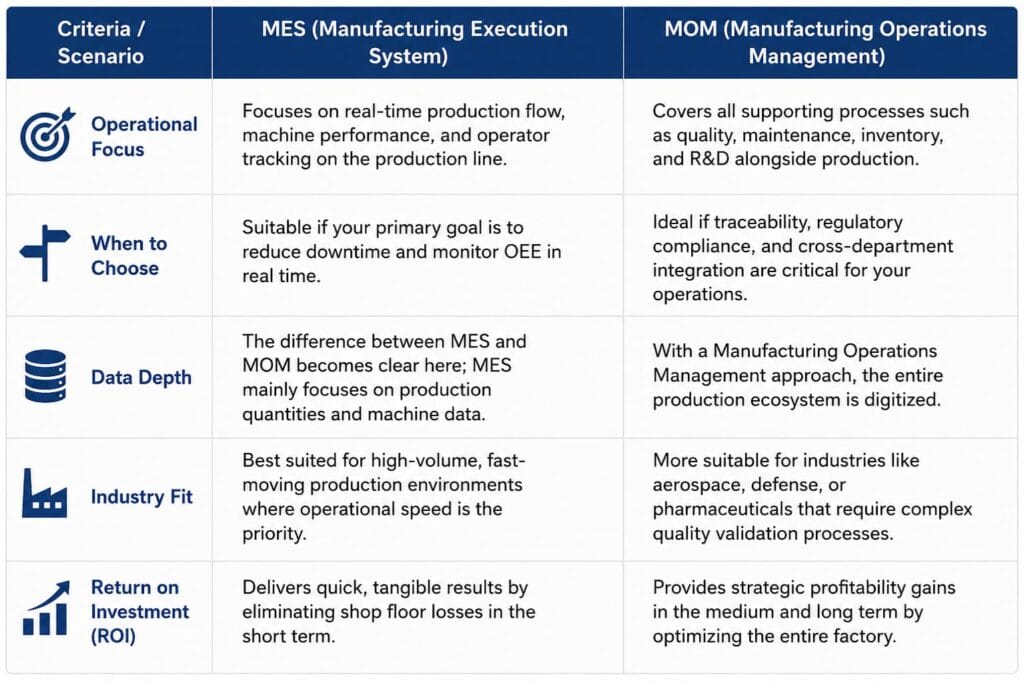
    In the landscape of industrial digitalization, the distinction between MES and MOM is pivotal for strategic decision-making. While these terms are frequently used interchangeably, they represent different architectural scopes within the smart factory ecosystem. Manufacturing Execution Systems (MES) traditionally focus on the real-time execution of production tasks directly on the shop floor. They are designed to act as the primary interface between the physical machinery and the higher-level enterprise systems.

    Manufacturing Operations Management (MOM) serves as a broader, more comprehensive framework that encompasses MES as one of its core components. Based on the ISA-95 international standard, MOM extends its reach beyond mere execution to include quality management, maintenance coordination, and inventory tracking. It provides a holistic view of the entire manufacturing facility rather than focusing solely on the assembly line. This “umbrella” approach ensures that all supporting departments are synchronized with the actual production flow.

    The fundamental difference lies in the breadth of integration and the complexity of the data being orchestrated. An MES is primarily concerned with “how” a product is being made in terms of machine status and output. Conversely, a MOM system evaluates “how well” the entire operation is performing by correlating production data with maintenance cycles and quality benchmarks. This broader perspective allows for deeper cross-functional analysis and more robust process optimization across the organization.

    Core Modules of MOM

    The strength of a management platform is measured by the breadth of the functions it covers and how well these functions are integrated with each other. Comprehensive MOM software gives you visibility into every stage of production, identifying efficiency losses down to the smallest detail. These structures are not just a software module, but a set of tools that support the manufacturing philosophy. Each module is responsible for managing a critical dataset for the overall success of the factory.

    At the core of the MOM architecture lies the standardization of operations on the shop floor. This standardization ensures consistent output quality across all shifts and operators. The scope offered within Manufacturing Operations Management represents the digital reflection of the journey from raw material intake to product shipment. Any anomaly that occurs during this journey is instantly detected by the system, and relevant units are notified.

    Quality management

    In manufacturing, quality is not only about inspecting the final product but about controlling the entire production process. Quality management modules within a MOM system monitor the course of production using Statistical Process Control (SPC) techniques. If a parameter tends to move beyond/outside the defined tolerance limits, the system can stop production or generate alerts. In this way, intervention occurs before defective products are produced, significantly reducing scrap rates.

    The digitalization of quality processes is also highly important for traceability. It is possible to identify within seconds which raw material batch, which machine, and which parameters were used to produce a product. MOM software stores quality records digitally, facilitating audit processes and preventing data entry errors caused by human factors. This acts as a protective shield for businesses, especially in regulated industries where high standards are mandatory.

    In traditional quality management approaches, data is usually analyzed after production is completed; however, in Manufacturing Operations Management, quality is an integral and real-time part of production. Operators verify approvals at every step by following digital checklists within the system. This proactive approach directly impacts profitability by reducing customer complaints and protecting brand reputation.

    Production planning

    One of the biggest bottlenecks in production environments is static plans that cannot adapt to dynamically changing conditions. Advanced MOM systems optimize production with finite capacity planning and scheduling capabilities. In the event of an unplanned machine downtime or a delayed raw material shipment, the system can recalculate the entire plan. This flexibility minimizes downtime and ensures the most efficient use of resources.

    The planning process includes not only machines but also human resources and equipment. Data such as which personnel are more skilled in certain work orders or which mold performs best on which machine are incorporated into planning. Through Manufacturing Operations Management, differences between theoretical capacity and actual performance are analyzed, enabling more realistic production schedules. This leads to improved adherence to delivery times and increased customer satisfaction.

    Scheduling modules also optimize complex production sequences, reducing setup times. By enabling the consecutive production of similar products, they save time on cleaning or mold changes. Modern MOM software can also consider energy costs during these optimizations. The resulting plan becomes a strategic document that accounts for all factory constraints and enhances efficiency.

    Maintenance systems

    The health of machines is a fundamental requirement for production continuity. The maintenance management module supports predictive maintenance strategies by monitoring real-time data from machines, enabling intervention before failures occur. Instead of the traditional “fix it when it breaks” approach, a data-driven “prevent it before it breaks” approach is adopted. This prevents unplanned downtime and ensures uninterrupted production during peak periods.

    Synchronizing maintenance activities with production plans is one of the greatest MOM benefits. The maintenance team can identify when a machine will be idle and plan interventions accordingly. At the same time, spare parts inventory used during maintenance is tracked through the system, preventing critical shortages. This integration reduces maintenance costs while extending machine lifespans.

    Maintenance management within the MOM system automatically calculates metrics such as team performance and MTBF (Mean Time Between Failures). These insights clearly reveal which machines have reached the end of their investment lifecycle or which components are prone to recurring issues. Processes managed through comprehensive MOM software create a proactive safety layer that reduces technical risks within the factory.

    Benefits of MOM Systems

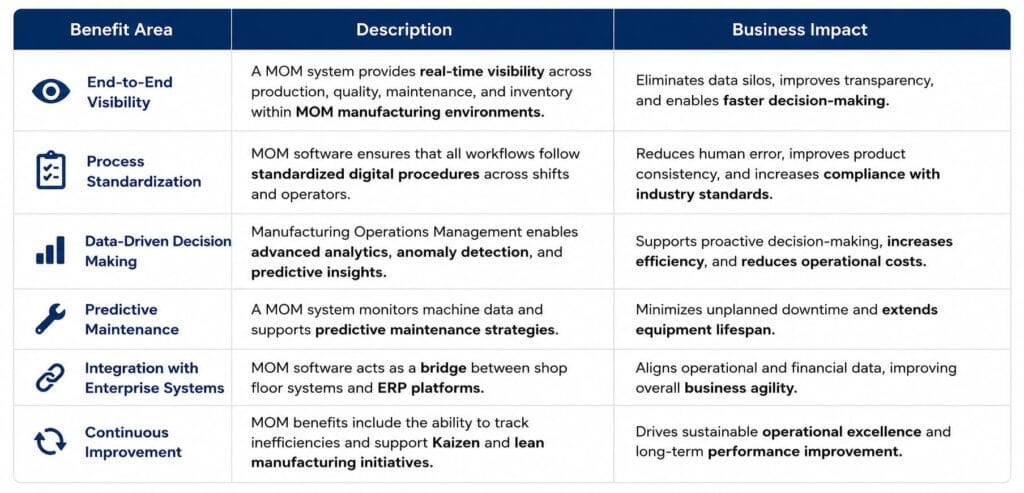
    In modern production environments, companies need more than just data—they need systems that turn data into measurable business value. A well-implemented MOM system enables this transformation by connecting all operational layers and driving continuous improvement across the factory.

    Mom Tablo

    The real value of Manufacturing Operations Management lies in its ability to create a connected, data-driven production environment where every decision contributes directly to efficiency, quality, and long-term competitiveness.

    Use Cases of MOM

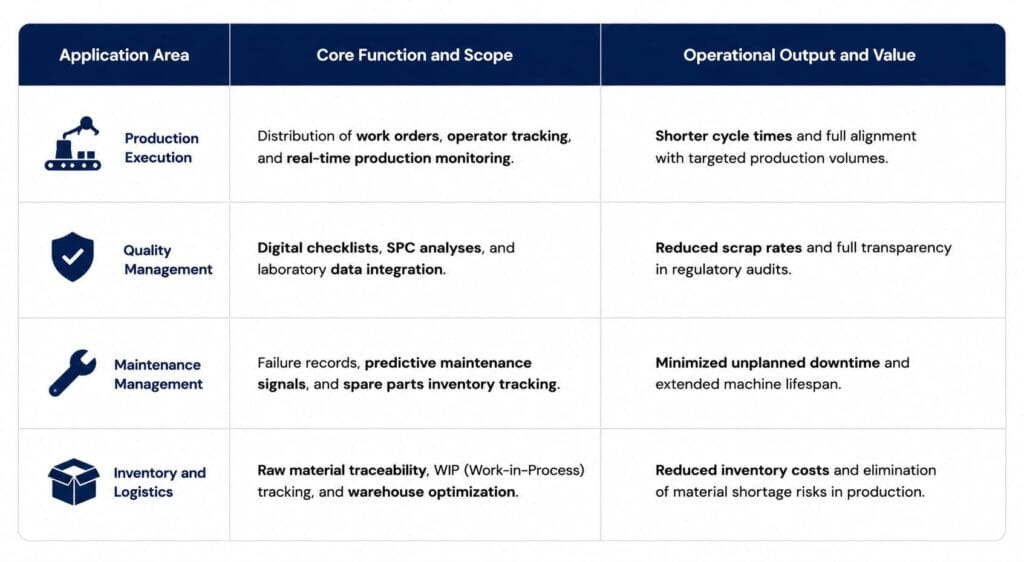
    MOM application areas are not limited to the production line alone; they cover a broad set of functions extending from quality laboratories to warehouse intake points. Each of these areas exchanges data with one another as a component of the Manufacturing Operations Management strategy. The table below summarizes the main application areas of these systems within the factory and their operational impact:

    mom tableWhen the table above is examined, it becomes clear that MOM application areas and the solutions they provide actually function like interlocking gears that complement one another. Tracking only production data in a factory means focusing solely on the visible part of the iceberg. Establishing true Manufacturing Operations Management is only possible when all of the functions listed in this table are synchronized on a digital platform. This holistic approach breaks down data silos between departments and enables the factory to operate with a shared intelligence.

    Restructure Your Production with the Power of Data

    Identify your losses in real time and optimize your operations with AI-driven recommendations. Increase production speed while reducing costs with our advanced MOM software platform. Take the next step in your digital transformation journey with a globally recognized and reliable MOM system.

  • MES Software for Small vs Large Manufacturers

    The global industrial landscape is rapidly shifting toward digitalization, making real-time visibility a necessity for both small and large manufacturers. As competition intensifies, businesses must move beyond manual tracking and adopt systems that transform raw production data into actionable insights. Choosing the right MES solution depends on operational scale, complexity, and future growth goals. Understanding these differences is key to building a scalable and efficient production environment.

    What is MES Software?

    At its core, MES software serves as the central nervous system of a manufacturing facility, bridging the gap between high-level business planning and shop floor reality. It functions as a dynamic information system that drives effective execution of manufacturing operations by tracking and documenting the transformation of raw materials into finished goods. By providing real-time data from the production line, it allows managers to optimize activities and increase overall equipment effectiveness (OEE). This layer of technology ensures that the right information is delivered to the right person at the right time.

    Modern manufacturing software has evolved from simple data logging tools into sophisticated platforms capable of complex decision support. These systems integrate directly with programmable logic controllers (PLCs) and IoT devices to capture high-frequency data without human intervention. This automated flow of information eliminates the risks associated with manual data entry, such as latency and transcription errors. Consequently, the shop floor becomes a transparent environment where every micro-stop and quality deviation is recorded for immediate analysis.

    The scope of a comprehensive system typically covers resource allocation, dispatching of production orders, and intensive data collection for performance analysis. It also plays a vital role in maintaining product genealogy and ensuring full traceability throughout the manufacturing lifecycle. By creating a digital thread of every operation, MES software enables companies to meet stringent regulatory requirements while improving internal quality standards. This foundational technology is what allows a factory to transform from a reactive environment into a proactive, self-optimizing unit.

    Furthermore, the integration capabilities of this software are what determine its long-term value within an organization. It must communicate seamlessly with Enterprise Resource Planning (ERP) systems to synchronize financial goals with physical production output. This bidirectional data flow ensures that production schedules are realistic and based on the actual capacity of the shop floor. In the era of Industry 4.0, having an integrated data ecosystem is the only way to achieve true operational excellence and sustainable growth.

    MES for Small Manufacturers

    Small manufacturers often face unique challenges, such as limited capital and a lack of dedicated IT personnel to manage complex deployments. For these organizations, agility is their greatest asset, and they require a digital solution that enhances this flexibility rather than stifling it. Implementing MES for small manufacturers focuses on rapid value realization and solving the most immediate bottlenecks, such as high scrap rates or unpredictable machine downtime. The goal is to provide a “light” yet powerful toolset that can be mastered quickly by a versatile workforce.

    In many cases, smaller production facilities rely on diverse machinery, some of which may be legacy equipment without modern communication protocols. A successful rollout of manufacturing software in this context involves using cost-effective IoT gateways and sensors to bring old machines into the digital age. This allows small-scale operators to gain the same level of visibility as their larger counterparts without replacing their entire machine park. Small manufacturers benefit immensely from this “bottom-up” approach to digitalization, where every small improvement in OEE directly impacts the bottom line.

    Cloud-based delivery models have revolutionized how small businesses access advanced technology. Software-as-a-Service (SaaS) options allow these companies to avoid heavy upfront investments in servers and database maintenance. By leveraging a subscription-based model, they can access high-end features while keeping their fixed costs low and manageable. This shift has democratized access to data, allowing smaller players to compete on quality and delivery speed in a globalized market.

    Cost considerations

    When evaluating a new system, MES pricing is often the primary concern for smaller enterprises with tight budgets. The total cost of ownership (TCO) includes not only the initial license or subscription fee but also the costs associated with hardware integration and staff training. Small manufacturers must look for solutions that offer a modular approach, allowing them to pay only for the features they currently need. This “pay-as-you-grow” strategy prevents the financial strain of over-investing in unnecessary functionality during the early stages of digital maturity.

    Calculating the return on investment (ROI) is crucial for justifying the expenditure to stakeholders in a small business setting. Savings are typically found in reduced labor costs for data collection, lower material waste, and improved machine utilization rates. If the MES pricing model is aligned with the scale of the operation, the system can often pay for itself within the first year of deployment. Understanding the hidden costs, such as the time spent by internal teams on implementation, is also vital for an accurate financial projection.

    Indirect costs, such as system maintenance and potential downtime during the transition, should also be factored into the budget. Small businesses should prioritize vendors that offer comprehensive support and easy-to-use interfaces to minimize the need for external consultants. By choosing a solution with a transparent MES pricing structure, manufacturers can avoid “vendor lock-in” and maintain control over their long-term digital strategy. Budgeting for continuous improvement and software updates ensures that the system remains an asset as the business scales.

    MES for Large Enterprises

    Large-scale industrial organizations operate in an environment characterized by extreme complexity, multi-site coordination, and vast amounts of data. For these entities, enterprise MES solutions are designed to standardize operations across different geographic locations and diverse product lines. The objective is to create a unified global standard for production reporting, quality control, and maintenance management. This standardization allows senior leadership to compare the performance of different plants on an “apples-to-apples” basis, driving internal benchmarking and healthy competition.

    The architecture of enterprise MES solutions must be robust enough to handle millions of transactions per day from thousands of connected devices. These systems often feature edge computing capabilities to process data locally before sending summarized insights to the central hub. This prevents network congestion and ensures that time-critical shop floor operations are not delayed by latency. Large enterprises require this high-performance infrastructure to maintain their production momentum and satisfy the demands of global supply chains.

    Strategic alignment with corporate IT policies is another critical factor for large manufacturers. The chosen manufacturing software must adhere to strict cybersecurity standards and data privacy regulations, especially when operating in multiple jurisdictions. Integration with existing corporate ecosystems, such as PLM, SCM, and global ERP instances, is mandatory to ensure data consistency. For large enterprises, the system is not just a shop floor tool; it is a critical piece of the global business intelligence strategy.

    Scalability

    Scalability is a non-negotiable requirement for any enterprise MES solutions deployed in a multinational context. The system must be able to support a growing number of users, machines, and sites without a degradation in performance. As a company expands through acquisitions or new factory builds, the software should allow for rapid replication of existing production models. This “template-based” deployment strategy significantly reduces the time and cost associated with bringing new facilities online.

    From a technical perspective, scalability also involves the ability to manage increasing data volumes and variety. As more sensors are added to the production environment, the MES software must be capable of ingesting and analyzing this “big data” in real-time. Advanced analytics and machine learning modules can then be layered on top of the scalable architecture to provide predictive insights. Large enterprises need this future-proof foundation to stay at the forefront of the Industry 4.0 revolution.

    Vertical and horizontal scalability must both be considered during the selection process. Vertical scalability ensures that a single site can handle more complex operations, while horizontal scalability allows the system to bridge multiple sites into a single cohesive network. A truly scalable manufacturing software platform adapts to the organizational structure, supporting centralized management while allowing for local operational nuances. This balance is key to maintaining agility within a massive corporate framework.

    Implementation complexity

    The sheer scale of a global rollout introduces a high level of implementation complexity that small manufacturers rarely encounter. Large enterprises must navigate diverse cultural backgrounds, varying technical skill levels, and established legacy processes at each site. Successful deployment of enterprise MES solutions requires a dedicated project management office and a clear change management strategy. Without a focus on the “human element,” even the most advanced technical solution can fail to gain traction on the shop floor.

    Technical integration with existing heterogeneous systems adds another layer of difficulty to the process. Many large factories have a mix of bespoke legacy software and modern third-party tools that must all be harmonized. Creating a unified data layer requires meticulous planning and a deep understanding of industrial communication protocols. This complexity is why large-scale manufacturing software projects often take months or even years to fully realize their global potential.

    Despite these challenges, the benefits of successfully navigating the implementation phase are immense. Centralized control over production standards leads to significantly higher brand consistency and lower global operational risks. Large manufacturers that invest in overcoming these complexities gain a “single version of the truth” that empowers data-driven decision-making at every level of the hierarchy. The complexity is the price of entry for achieving world-class manufacturing efficiency and global market dominance.

    Key Differences in Usage

    The way different manufacturers utilize MES software varies significantly based on their strategic priorities. Small manufacturers typically use the system as a tactical tool to gain visibility into daily production hurdles and to prove quality to their customers. Their focus is often on high-impact, low-complexity modules like downtime tracking and basic OEE reporting. In contrast, large manufacturers use the system as a strategic platform to optimize entire value chains and manage global risk.

    Data granularity is another area where usage patterns diverge between small and large players. A small shop might only need to track output per shift or per machine to maintain their margins. However, an enterprise-level user of manufacturing software might track every single component via serial number through a multi-stage global assembly process. This high-resolution data is used for advanced root cause analysis and to manage complex warranty and recall scenarios. The depth of the data captured is directly proportional to the complexity of the product and the regulatory environment.

    Customization requirements also differ, with smaller companies preferring “out-of-the-box” functionality to keep MES pricing low. Large organizations, however, often require highly customized workflows to match their unique, proprietary manufacturing processes. These enterprises have the resources to build custom modules and integrate advanced AI algorithms into their digital ecosystem. While the core technology remains similar, the application of that technology is tailored to the specific operational scale and strategic goals of the business.

    Choosing the Right MES Solution

    Selecting the most suitable manufacturing software requires a thorough assessment of both current pain points and long-term business objectives. Decision-makers should begin by defining their “must-have” features versus “nice-to-have” enhancements to avoid unnecessary costs. It is essential to involve stakeholders from production, IT, and quality departments early in the evaluation process to ensure cross-functional buy-in. A solution that works for the IT team but is rejected by shop floor operators will never deliver its promised value.

    Vendors should be evaluated based on their industry-specific experience and their track record with companies of a similar scale. For those looking for MES for small manufacturers, the focus should be on ease of use, fast deployment, and transparent subscription costs. Larger organizations should prioritize vendors capable of supporting global rollouts and offering deep integration with major ERP platforms. Testing the software through a pilot program or a “Proof of Concept” (PoC) on a single production line is a highly recommended way to verify performance before a full-scale commitment.

    Consider the vendor’s roadmap and their commitment to emerging technologies like AI, AR, and advanced robotics. The right MES software is an investment in the future of the factory, and it should be capable of evolving as new industrial trends emerge. Flexibility, scalability, and a strong support network are the hallmarks of a technology partner that will help your business thrive in the digital age. By making an informed choice today, you lay the foundation for a more efficient, transparent, and profitable manufacturing future.

    Maximize OEE and Production Speed with ProManage!

    Are you ready to unlock the full potential of your manufacturing operations, regardless of your company’s size? Whether you are looking for an affordable entry point or a robust enterprise MES solution, ProManage provides the visibility and intelligence needed to double your production speed and maximize OEE. Join the ranks of smart factories worldwide that trust our Gartner-recognized expertise to lead their digital transformation journey. Schedule a demo and see how we can tailor our technology to your unique manufacturing needs!
  • What is MES (Manufacturing Execution System)?

    The manufacturing world has entered a radical transformation process with digital transformation and Industry 4.0. In this new era, businesses need to manage their shop floor operations in a more transparent, traceable, and data-driven way. Manufacturing Execution Systems (MES), with their structure that monitors, controls, and optimizes all production processes in real time, provide a powerful solution to this need. In this article, we will elaborate on this structure—considered the central nervous system of production—its functioning, and the revolutionary value it brings to industry.

    Definition of MES

    When it comes to the digitalization of production processes, the first question that comes to mind is “What is MES?” The Manufacturing Execution System is an integrated information system that manages, monitors, and reports all production operations in real time, from the entry of raw materials into the factory to the shipment of finished products. In other words, MES establishes the data bridge between physical production activities on the shop floor and upper-level management systems (ERP).

    An MES software solution does not only collect data; it also interprets this data to provide transparent visibility into what is happening on the production floor. According to ISA-95 standards, business management systems such as Enterprise Resource Planning (ERP) are positioned at Level 4, while shop floor control systems operate at Levels 1 and 2. MES is positioned at Level 3 between these two worlds, ensuring operational excellence. Therefore, a Manufacturing Execution System functions as the digital brain of a factory, monitoring its real-time pulse and enabling strategic decision-making.

    Key Functions of MES

    One of the most critical questions manufacturers ask when investing is: “What does MES do?” The main goal of these systems is to enhance operational performance by bringing all inefficiencies in production processes into clear view. As a production tracking system, the key objectives MES focuses on can be summarized as follows:

    1. Optimizing Production Output: Increasing the amount of high-quality products produced per unit time by ensuring the most efficient use of resources.
    2. Reducing Losses: Identifying unplanned downtimes, speed losses, and quality defects in real time and eliminating their root causes.
    3. Ensuring Transparency: Providing managers with data-driven decision-making capabilities by reporting everything happening across the factory in real time.
    4. Reducing Costs: Increasing profitability by minimizing scrap rates, optimizing energy consumption, and lowering inventory costs.

    How MES Works

    Although it may seem complex, a Manufacturing Execution System operates with a highly systematic data cycle. The process begins with collecting data from machines and equipment on the shop floor, continues with analyzing this data, and ultimately returns as an action plan for operators or managers.

    Real-Time Data Tracking

    For a modern production tracking system, the most critical capability is capturing data instantly. Thanks to IoT devices and smart sensors, machine statuses, rotation speeds, cycle times, and energy consumption are captured within seconds. When addressing the question “What is MES?”, this emphasis on real-time capability is crucial, because learning about a failure that occurred 10 minutes ago can lead to delays that are difficult to compensate for in the production line. With real-time data tracking, bottlenecks can be addressed before they occur.

    Production Line Integration

    MES is not just a passive observer that collects data from machines. An active Manufacturing Execution System establishes bidirectional integration with the production line. For example, if a product fails during quality control, MES can immediately stop the next process or send commands to the line’s routing system (sorter) to separate the defective product. Fully integrated with operator panels (HMI), digital work instructions, and ANDON displays on the shop floor, this structure ensures that every cell of the factory operates in alignment with a unified digital plan.

    Components of MES System

    MES is an ecosystem consisting of hardware, software, and a database. The core building blocks of this system include data collection terminals, IoT gateway devices, quality management modules, maintenance management systems, detailed scheduling tools, and advanced reporting interfaces. The harmony of these components directly determines the performance of the MES software.

    Relationship Between ERP and MES

    One of the frequently asked questions in the business world is: “We already have ERP—do we need an additional investment in MES software?” The answer is a clear yes. While ERP systems focus on the financial and logistical aspects of the business (what to produce, who to sell to), the Manufacturing Execution System focuses on how and when production happens. While ERP plans the “breathing” of the factory, MES manages its “heartbeat.” Thanks to the integration between the two, top management can instantly update logistics and financial plans based on real-time production data.

    Benefits of MES

    For a facility, adopting a production tracking system is not just a technological transformation—it is a financial leap. Implementing MES software is one of the most strategic steps to control chaos, reduce costs, and keep up with the speed of the digital age. Here are the key MES benefits:

    • OEE Increase and Capacity Gains: By identifying hidden downtimes, facility capacity can be increased by 15–30% without additional investment.
    • Cost Savings: Profit margins improve by minimizing scrap, waste, and rework costs.
      Paperless Production: A fast, environmentally friendly digital work environment is established by eliminating the risk of manual data entry errors.
    • Faster Time-to-Market: Delivery times are shortened by eliminating bottlenecks in production processes.
    • Sustainability: Carbon footprint is reduced through energy monitoring and resource optimization.

    Industries Where MES is Used

    Today, the Manufacturing Execution System has become a strategic necessity in every area where production exists—from food to furniture, from pharmaceuticals to textiles. Below are the key industries where MES software is most widely used and where digital transformation delivers tangible results:

    • Automotive and Tier Suppliers: In the automotive world, every second counts. Thousands of components must come together under Just-in-Time (JIT) and Just-in-Sequence (JIS) principles. Here, the answer to “What is MES?” is flawless assembly and perfect traceability. MES records torque values, component lot numbers, and assembly details for each vehicle based on chassis numbers, preventing quality issues before they occur and reducing recall costs.
    • Food and Beverage: The primary focus in this sector is sustainability, hygiene, and “farm-to-fork” traceability. A production tracking system manages all recipe processes from raw material intake to final product. MES plays a vital role in expiration date tracking, allergen management, and reducing waste. In case of an issue, the system can instantly trace affected batches and protect brand reputation.
    • Pharmaceuticals and Biotechnology: Digitalization is not optional but mandatory in this sector. Compliance with strict standards such as FDA and GMP requires a paperless Manufacturing Execution System. Electronic Batch Records (EBR), sterilization tracking, and contamination risk management are only possible with advanced MES software.
    • Plastic Injection and Packaging: In this field, where cycle times are measured in milliseconds, machine efficiency defines profitability. MES maximizes OEE by monitoring mold change times (SMED), energy consumption, and quality parameters. Even the smallest performance drops are instantly detected and reported.
    • Metal Processing and Machinery Manufacturing: In CNC operations and complex machining processes, material usage and tool life tracking are critical. A production tracking system reduces material waste while ensuring accurate capacity planning. It also provides transparency into operator performance and downtime causes.
    • Electrical and Electronics: In industries where many small components come together on fast assembly lines, testing processes and labor efficiency are crucial. MES tracks products based on serial numbers and records test results, eliminating bottlenecks and increasing assembly speed.
    • Chemicals and Cosmetics: In batch production environments, precise recipe management and raw material dosing are essential. A Manufacturing Execution System ensures consistent quality by controlling every stage from tank levels to mixing times.
    • Textile and Apparel: Measuring efficiency in labor-intensive processes such as weaving, dyeing, and sewing is challenging. MES digitalizes machine downtime and operator performance, enabling cost control and offering specialized solutions like fabric defect mapping.
    • Construction, Furniture, and Building Materials: Flexibility is key in industries with increasing customized production. MES distributes custom job orders from ERP to the shop floor without errors, optimizing material cutting and assembly processes while shortening delivery times.
    • Defense and Aerospace: In sectors where error tolerance is zero and traceability standards (such as AS9100) are extremely high, MES maintains a complete genealogy of every component, ensuring audit readiness at all times.
    • FMCG (Fast-Moving Consumer Goods): In high-speed filling and packaging lines, unplanned downtime results in massive product losses. MES software integrates with sensors to detect performance drops instantly and supports the goal of zero downtime.

    Transform Your Factory with Real-Time Intelligence

    Would you like to eliminate inefficiencies in your facility, turn your losses into profit with real-time visibility, and stay competitive in the global arena? Recognized by Gartner as one of the world’s top 20 MES solutions and powered by artificial intelligence, ProManage makes all processes in your factory transparent and provides an automatically improving operational structure.

    Take the first step today to go beyond managing your production facility and experience the tangible results of digital transformation in your own factory.

  • MES vs MOM: What’s the Real Difference?

    In today’s competitive landscape, companies must transform real-time shop floor data into strategic insight to stay ahead. At this point, MES vs MOM becomes a critical discussion, as both concepts represent different stages in the digitalization journey of manufacturing. The key question is whether a business should focus on improving speed on the production line or optimize the entire factory operation. This decision defines the difference between MES and MOM.

    Overview of MES and MOM

    A Manufacturing Execution System (MES) is designed to monitor, control, and optimize production processes in real time—from raw material input to finished goods output. It processes data collected from machines, operators, and sensors, providing instant visibility into production status. MES ensures that production plans are accurately executed on the shop floor and that operators follow standardized workflows.

    Manufacturing Operations Management (MOM), on the other hand, goes beyond execution and covers all operational processes across the factory. It integrates production with quality management, maintenance operations, inventory tracking, and even R&D processes. For many professionals entering the field, the question “What is MOM?” naturally arises. The answer lies in its ability to unify all supporting processes of manufacturing under a single digital framework.

    MOM is often defined within the scope of ISA-95 standards as a methodology covering all Level 3 operations. It not only evaluates how production is performed but also analyzes how supporting processes influence production outcomes. By synchronizing departments, MOM aims to improve overall equipment effectiveness (OEE) and drive enterprise-wide efficiency.
    While MES systems typically operate with a vertical focus on production, MOM provides horizontal integration across departments. MES tracks machine performance and downtime in real time, whereas MOM connects these events with maintenance schedules and spare parts availability. Businesses must manage this transition based on their level of digital maturity.

    Key Differences Between MES and MOM

    Understanding MES vs MOM requires analyzing their focus areas and scope. The difference between MES and MOM is not only technical but also conceptual. MES concentrates on how production is executed at a granular level, while MOM provides a broader view of how operations are managed across the organization.

    From a process management perspective, MES is essential for real-time intervention and operational discipline. MOM enhances this discipline by integrating additional layers such as quality control, inventory tracking, and predictive maintenance. The commonly discussed MES vs MOM comparison ultimately reflects a balance between specialization and expansion—one system speaks the language of machines, while the other represents the language of the entire factory.

    Operational vs strategic systems

    MES delivers the tactical and operational data required to meet shift-based production targets. It identifies why a machine stops or when an operator deviates from standard time, enabling supervisors to take immediate corrective actions. In this sense, MES functions as the real-time control system of the production floor.

    MOM, however, operates at a more strategic level. It uses collected data not only to resolve immediate issues but also to improve overall workflows. From maintenance team performance to supply chain impact on production speed, MOM provides a comprehensive perspective. This enables senior management to make informed long-term investment and capacity planning decisions.

    At the strategic level, the integration and interpretation of data become critical. Here, the difference between MES and MOM becomes clear: MES generates data, while MOM combines it with inputs from other departments to create meaningful insights. Optimizing profitability requires improving not just production but all surrounding operations—something only achievable through a strategic MOM approach.

    Data scope differences

    MES systems typically focus on production orders, machine performance, downtime, and scrap rates. While valuable, this data offers a limited view of the overall health of the factory and often remains isolated within the production department.

    MOM systems, in contrast, provide a much broader data scope. They integrate inputs from quality labs, warehouse systems, and maintenance records. A well-structured MOM environment analyzes how machine parameters affect product quality and builds a learning ecosystem that reduces errors over time.

    In terms of data depth, MES vs MOM also differs in how data is utilized. MES primarily uses data for visualization and reporting, while MOM processes it through advanced algorithms to generate optimization recommendations. In MES, data is an outcome; in MOM, it becomes the driving force of continuous improvement (Kaizen). This makes comprehensive data integration essential in modern manufacturing systems comparison.

    Functional Comparison

    When selecting between these systems, companies must evaluate functional capabilities, as they directly impact return on investment (ROI). A typical MOM vs MES comparison shows that MOM encompasses MES functionalities, but not every organization requires such extensive coverage.

    MES focuses on production-specific functions such as work order management, scheduling, and resource allocation. These features standardize workflows and reduce operational complexity on the shop floor.

    MOM extends these capabilities by adding document management, workforce competency tracking, and advanced performance analytics. This transforms MOM from a production tool into a comprehensive operations management platform.

    The difference in functional depth also affects system flexibility. MES is often tailored to specific production types, while MOM’s modular structure allows it to adapt and scale according to changing business needs. Any manufacturing systems comparison highlights that functional alignment with digital maturity is key to success.

    Integration capabilities

    Integration capability is one of the most critical factors in digital transformation success. MES systems typically integrate with ERP systems, receiving production orders and reporting output. While this creates a basic link between production and finance, it can leave operational gaps.

    MOM systems integrate with a wider ecosystem, including PLM, LIMS, and WMS. This enables real-time updates across the entire value chain—for example, reflecting product design changes instantly on the production floor. MOM acts as a bridge between all data sources, creating a single source of truth.

    As integration increases, predictive capabilities also improve. A MOM system can anticipate how supply chain delays will impact production schedules. This is where MES vs MOM becomes especially relevant—MES manages current operations, while MOM anticipates future disruptions. Such integration enhances agility and adaptability in modern factories.

    Which One Should You Choose?

    MES and Mom

    This manufacturing systems comparison serves as a guide to understanding where your organization stands in its digital transformation journey. Choosing the right system is not only about addressing current needs but also about supporting your future scalability goals. The right solution is the one that clearly reveals production bottlenecks and supports decision-making with data-driven insights.

    If micro-level control and shop floor discipline are your priorities, investing in MES is a logical first step. However, if your goal is to transform your factory into a fully synchronized, intelligent organization where all departments operate in harmony, then adopting a MOM platform is the more strategic choice.

    Start Transforming Your Manufacturing Operations

    Turning production data into strategic value is no longer optional—it is essential. ProManage combines the capabilities of MES and MOM into a single AI-powered platform, helping your business evolve into a smart factory.

    With IoT-enabled infrastructure, you can detect losses instantly and automate continuous improvement processes using Agentic AI. Take action today to define your digital transformation roadmap and meet the standards of the future.

  • What is a Smart Factory?

    The world of manufacturing is undergoing one of the fastest and most radical transformations in history. Traditional production methods are giving way to data-driven, self-optimizing systems that can predict errors in advance. At the heart of this new era lies the question: “What is a Smart Factory?” which determines the competitiveness of manufacturers. Let’s examine this concept, which is not just a technology trend but a way of doing business, in all its dimensions.

    Smart Factory Definition

    A Smart Factory is a manufacturing facility where machines, systems, and objects constantly communicate with each other and with humans over a network, and where production processes are simulated and managed in real-time within a digital world. This structure is built upon Cyber-Physical Systems (CPS). In other words, every physical movement in the factory has a counterpart in the digital world. While data in traditional factories is tracked through manual methods or limited reports after production is completed; in a digital factory, data starts flowing from the field the very second production occurs.

    The most important component of this definition is connectivity. In smart factories, machines do not just operate; they also report to the system how much energy they consume, how much scrap they produce, and when they might malfunction. Global-scale MES (Manufacturing Execution Systems) like ProManage act as a “brain” managing this massive data flow, transforming raw data into strategic business insights. Therefore, it is possible to define a Smart Factory as “an integrated technology platform where data turns into products, and products turn into value.”

    In a traditional factory, when a machine stops, the operator’s declaration or past reports are checked to understand the reason. In a Smart Factory, however, the system detects the cause of the downtime (mechanical failure, material shortage, operator error, etc.) within the microsecond it occurs. This closes the era of “forecast-based management” and opens the era of “data-driven management.”

    The Relationship Between Industry 4.0 and the Smart Factory

    Industry 4.0 symbolizes the fourth revolution, representing the pinnacle of digitalization in industrial history. Smart factories are the heart and the greatest output of this revolution. The Industry 4.0 vision aims to integrate the Internet of Things (IoT), cloud computing, and artificial intelligence technologies into the production field. A Smart Factory is where these technologies come together and transform into a tangible production model.

    The core philosophy of Industry 4.0, “Mass Customization,” can only be realized through a smart facility infrastructure. In traditional facilities, production lines are rigid and cumbersome; switching from one product type to another takes hours, sometimes days. However, smart factories adapt to market demands and customer expectations within minutes, thanks to the flexibility offered by Industry 4.0. This relationship allows the factory to stop being just a place that produces and instead gain an agile structure integrated with the entire supply chain and focused on the customer. The success of the smart manufacturing model depends on how harmoniously field flexibility is managed with digital systems. Every facility that achieves this harmony transforms into an example of a digital factory that stands out in competition.

    Within the scope of Industry 4.0, smart factories work in integration not only internally but also with their suppliers and customers. A delay at a raw material supplier is instantly perceived by the Smart Factory’s production planning algorithm, and the production schedule is autonomously revised accordingly. This is a holistic digital ecosystem that minimizes the margin of error.

    Technologies Behind Smart Factories

    The intelligence of a factory is determined by the synergy between its hardware and software. These technologies act as the eyes, ears, and brain of the operation.

    AI in manufacturing

    AI in manufacturing serves as the analytical brain of the facility. While humans can monitor a few screens, AI can analyze millions of data points per second. It goes beyond telling you what happened; it explains why it happened and predicts what will happen next. Advanced AI algorithms can optimize production schedules, suggest the most efficient energy consumption routes, and identify patterns that lead to quality defects before they even occur.

    IoT integration

    The Internet of Things (IoT) is the nervous system of the Smart Factory. IoT integration involves embedding sensors into every piece of equipment—including legacy machinery. This allows conventional, non-connected machines to be transformed into intelligent assets that broadcast their status, temperature, and performance. This constant stream of data is what fuels the central management systems (MES), providing a 100% accurate view of the shop floor at any given microsecond.

    Benefits of Smart Manufacturing

    Adopting a smart manufacturing model is no longer a luxury; it is a requirement for staying competitive. The benefits are measurable and immediate:

    • Increased OEE: By eliminating the “hidden” causes of downtime, factories see a massive boost in Overall Equipment Effectiveness.
    • Predictive Maintenance: Instead of waiting for a machine to break (reactive) or changing parts too early (preventative), the system tells you exactly when maintenance is needed (predictive).
    • Reduced Waste: Real-time quality monitoring ensures that if a process goes out of spec, the system catches it immediately, saving raw materials and energy.
    • Data-Driven Decisions: Management no longer relies on “gut feelings” or potentially biased operator reports. Decisions are based on 100% objective, real-time data.

    Automation systems

    In a Smart Factory, automation goes beyond simple repetitive tasks. Modern automation systems feature Machine-to-Machine (M2M) communication. For instance, if a production line is running low on components, the system automatically signals Autonomous Mobile Robots (AMRs) or AGVs to fetch supplies from the warehouse without human intervention. This creates a seamless flow that maximizes throughput and minimizes human error.

    Real-world Examples

    The impact of shifting to a digital factory model is backed by data. Statistics show that facilities implementing advanced MES solutions, such as ProManage (recognized by Gartner as one of the top 20 MES solutions globally), see dramatic improvements.

    For example, many enterprises have reported moving their OEE rates from a stagnant 58% to over 70%, while simultaneously increasing total production capacity by up to 35%. These aren’t just incremental gains; they are transformative shifts that allow companies to lead their respective industries.

    Ready to Lead the Future?

    Digital transformation is a journey of continuous improvement (Kaizen). The question is not whether the industry will change, but whether your facility will be a leader or a follower in the era of Industry 4.0.

    By transforming raw data into an automated action plan, you can minimize costs and maximize your profit margins. Start your journey toward a more transparent, faster, and more profitable production facility today.